Understanding Even and Odd Functions: A Review of Symmetry and Function Properties
40 likes | 156 Vues
This warm-up activity reviews the key properties of even and odd functions, emphasizing their symmetry to the y-axis and the origin, respectively. An even function satisfies f(-x) = f(x) for all x in its domain, while an odd function satisfies f(-x) = -f(x). Students will investigate whether given functions are even or odd and fill out a chart to prepare for their Unit 1 Test. They will learn fundamental concepts such as determining if an equation represents a function, evaluating functions, and exploring the domain and range, including operations and compositions of functions.


Understanding Even and Odd Functions: A Review of Symmetry and Function Properties
E N D
Presentation Transcript
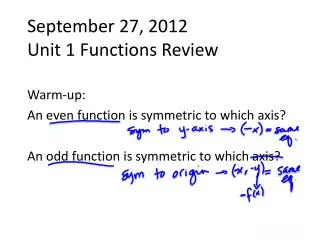
September 27, 2012Unit 1 Functions Review Warm-up: An even function is symmetric to which axis? An odd function is symmetric to which axis?
How can we relate the symmetry tests to functions? A function y = f(x) is even if, for each x in the domain of f, f(-x) = f(x) A function y = f(x) is odd if, for each x in the domain of f, f(-x) = -f(x) Check if the function is even or odd and state whether it is symmetric to the y-axis or origin.
Fill out the chart to help organize our Unit 1 TestUse f(x) = x2 – 9 to find the following
Unit 1 Functions Test • Determine whether an equation is a function of x. • Domain, given an equation • Domain and range, given a graph • Evaluating functions • Zeros of functions • Increasing, decreasing, constant • Rate of Change • Combination of functions, (f + g)(x), (fg)(x), etc. • Composition of functions, (fog)(x) and stating the domain. • Inverses of functions – algebraically and graphically