Complex Zeros of Polynomial
140 likes | 282 Vues
In this resource, you will explore the fundamental concepts of complex zeros in polynomial functions, including two major theorems: the Fundamental Theorem of Algebra and the Linear Factorization Theorem. Learn about the properties of complex conjugate zeros, and how to factor polynomials with real coefficients. You'll watch informative videos and understand how to identify the zeros of specific polynomial functions, along with their x-intercepts. This knowledge is essential for deeper insights into polynomial equations and complex analysis.


Complex Zeros of Polynomial
E N D
Presentation Transcript
Complex Zeros of Polynomial By: Mao & Na
Introduction: What you'll learn about : • Two Major Theorems • Complex Conjugate Zeros • Factoring with Real Number Coefficients.
Video • http://www.youtube.com/watch?v=J2TYyUftI8k
Two Major Theorems • Fundamental Theorem of Algebra: A polynomial function of degree n has n complex zeros( real or nonreal). Some of these zeros may be repeated. • Liner Factorization Theorem:If f(x) is a polynomial function of degree n >0, then f(x) has precisely n linear factors and • f(x) = a(x –z1)(x –z2) ..... (x -zn) • Where a is the leading coefficient of f(x) and z1, z2,….., zn are the complex zeros of f(x). The zi are not necessarily distinct numbers; some may be repeated.
Fundamental Polynomial Connections in the Complex Case: The following statements about a polynomial function f are equivalent if k is a complex number.1. x = k is a solution (or root) of the equation f(x) = 02. is a zero of the function f.3.x - k is a factor of f(x).
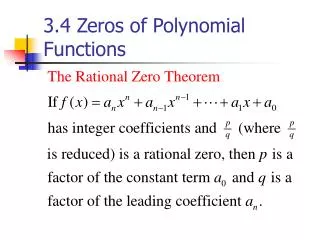
Complex Conjugate Zeros Suppose that f(x) is a polynomial function with real coefficients. If a and b are real numbers with b not equal 0 and a + bi is a zero of f(x), then its complex conjugate a - bi is also a zero of f(x).
Factoring with Real Number Coefficients Let f(s) be a polynomial function with real coefficients. The Linear Factorization Theorem tells us that f(x) can be factored into the form f(x) = a(x –z1)(x –z2) ..... (x -zn),Where zi are complex numbers. Recall, however, that nonreal complex zeros occur in conjugate pairs. The product of x - (a + bi) and x - (a - bi) is [x-(a+bi)][x-(a-bi)] = x^(2) - (a-bi)x - (a+bi)x + (a+bi)(a-bi) = x^(2 ) - 2ax + ((a^2) + (b^2)).
Factoring with Real Number CoefficientsEvery polynomial function with real coefficients can be written as a product of linear factors and irreducible quadratic factors, each with real coefficients. Polynomial Function of Odd Degree Every polynomial function of odd degree with real coefficients has at least one real zero.
Complex Zeros of Polynomial Find complex zeros of polynomial function : F(x) = 3x^(4) + 5x^(3) + 25x^(2) + 45x – 18 http://www.youtube.com/watch?v=YoSs6KJ6I9c
/// / /
Assessment of Content Write the polynomial in standard from, and identify the zeros of the function and the x-intercept of it’s graph. 1.f(x)=(x-3i)(x+3i) A. x2+9; zeros:+-3i: x-intercepts: none B. x2+6; zeros:+-3i: x-intercepts: 2 2.f(x)=(x-1)(x-1)(x+2i)(x-2i) A. X4-3x+25x-4x+4 B. X4-2x+5x-8x+4 Write the polynomial function of minimum degree in standard form with real coefficient whose zeros included those listed. 3. I and – I A. x3+4 B. x2+1 4. 2,3 and I A. X4-5x3+7x-5x+6 B. X2-2x2+7x-3x+4 State how many complex and real zeros the function has. 5. f(x)=x2-2x+7 A. 2 complex zeros: none real B. 4 complex zeros: 7 real 6. F(x)=x4-5x3+x2-3x+6
Assessment of Content continue Find all of the zeros and write a linear factorization of the function. 7. f(x)= x3+4x-5 A. Zeros: x=1, x = -1/2 ±√ 19/2 i ; f(x) = ¼ (x-1)(2x+1+ √19i) (2x+1- √ 19i) B. Zeros: x=2, x = -1/2 ±√ 19/2 i ; f(x) = ¼ (x-1)(2x+1+ √19i) (2x+1- √ 19i) 8. f(x)= x4+x3+5x2-x-6 A. Zeros: x= ± 1, x = -1/2 ±√ 23/2i ; f(x) = ¼ (x-1)(x+1)(2x+1+ √ 19i) (2x+1- √ 23i B. . Zeros: x= ± 1, x = -1/2 ±√ 23/2i ; f(x) = ¼ (x-1)(x+1)(2x+1+ √ 19i) (2x+1- √ 23i Using the given zeros, find all of the zeros and write a linear factorization of f(x). 9. 1+i is a zeros of f(x)=x4-2x3-x2+6x-6 A. Zeros: x=2 x = -1/2 ±√ 19/2 i ; f(x) = ¼ (x-1)(3x+1+ √ 19i) (3x+1- √ 19i) B. Zeros: x=1, x = -1/2 ±√ 19/2 i ; f(x) = ¼ (x-1)(2x+1+ √ 19i) (2x+1- √ 19i) 10. 3-2i is a zeros of f(x)=x4-6x3+11x2+12x-26 A. Zeros: x +- √ 2. x =3 ± 2i: f(x) = (x- √ 2) ( x+ √ 2)(x-3+2i)(x-3-2i). B. Zeros: x +- √ 4. x =3 ± 3i: f(x) = (x- √ 2) ( x+ √ 2)(x-3+2i)(x-3-2i).
Answer Key • x2+9; zeros:+-3i: x-intercepts: none • X4-2x+5x-8x+4 • x2+1 • X4-5x3+7x-5x+6 • 2 complex zeros: none real • 4 complex zeros: 2 real • Zeros: x=1, x = -1/2+- √ 19/2 i ; f(x) = ¼ (x-1)(2x+1+ √19i) (2x+1- √ 19i) • Zeros: x= ± 1, x = -1/2+- square root 23/2i ; f(x) = ¼ (x-1)(x+1)(2x+1+square root 19i) (2x+1- square root 23i) • Zeros: x +- √ 3. x =1 +- i: f(x) = (x- √ 3) ( x+ square 3)(x-1+i)(x-1-i). • Zeros: x +- √ 2. x =3 +- 2i: f(x) = (x- √ 2) ( x+ √ 2)(x-3+2i)(x-3-2i).
Works Cited Demana, Franklin. Waits, Bert K.. Foley, Gregory D.. Kennedy, Daniel. Pre- Calculus. Eight Edition. Graphical, Numerical, Algebraic. "Finding Complex Zeros of a Polynomial Function." YouTube. YouTube, 10 Oct. 2011. Web. 21 Jan. 2013. "X Finds Out His Value." YouTube. YouTube, 31 Dec. 2008. Web. 21 Jan. 2013.