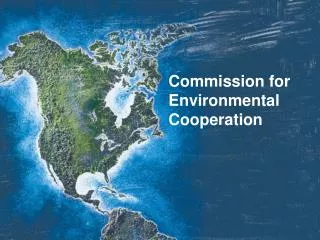
Commission for Environmental Cooperation
150 likes | 263 Vues
The Commission for Environmental Cooperation (CEC) fosters collaboration between Canada, Mexico, and the United States to protect our shared environment, which supports over 400 million people. Established alongside NAFTA, the CEC prioritizes initiatives such as the Children's Health and the Environment Initiative, focusing on issues like asthma, toxic chemicals, and waterborne diseases. This initiative integrates public participation and expert advisory input to develop a cooperative agenda aimed at enhancing children's health and promoting environmental conservation across North America.


Commission for Environmental Cooperation
E N D
Presentation Transcript
Three Countries. One Environment.
In North America • 400 million people • Shared ecosystem • Transboundary flow of air, water, species • Open economy • $11 trillion goods/services • NAFTA – doubled trade since 1993
Commission forEnvironmental Cooperation • Canada, Mexico, United States created CEC to better protect our shared environment • North American Agreement on Environmental Cooperation – parallel agreement to NAFTA
CEC Mission Cooperation, public participation to foster conservation, protection, and enhancement of the environment… … In the context of increasing economic and trade links
Children’s Health and the Environment Initiative • Initiated in 2000 following North American symposium • Initial focus, as defined by Council, on: asthma and respiratory disease, the effects of lead and other toxic chemicals, waterborne diseases • Guided by Cooperative Agenda for Children’s Health and the Environment in North America
Children’s Health and the Environment Initiative • Expert Advisory Board on Children’s Health and the Environment - provides advice to Council • Trilateral Children’s Environmental Health Team - advances implementation of Council priorities
Cooperative Agenda for Children’s Health and the Environment in North America • Adopted by CEC Council in June 2002 • Serves as blueprint for trilateral action to advance the protection of children from environmental threats to their health • Developed with the involvement of environment and health officials and the public • Intended as a “living” document to be reviewed and updated bi-annually
Cooperative Agenda Projects • Development of Indicators of Children’s Health and the Environment • Economic Valuation of Children’s Environment-Related Illnesses– first report on asthma and respiratory diseases • North American Workshop on Risk Assessment and Children’s Environmental Health
Cooperative Agenda Projects • Education and training of Health Care Professionals • Market study to foster the shift to lead-free pottery in Mexico • Trilateral workshop on lead in consumer projects, Fall 2003
Potential for Collaboration 1. Exchange of ideas 2. Adoption of principles 3. Endorsement of programs 4. Research & education