PRAGMATISM
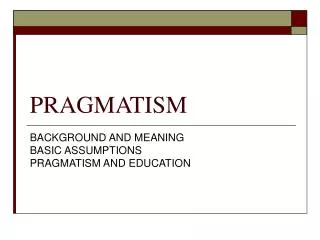
PRAGMATISM. BACKGROUND AND MEANING BASIC ASSUMPTIONS PRAGMATISM AND EDUCATION. Pragmatism. It emerged in 19 th century in America out of empiricist view, that knowledge is acquired through experience. Philosophers: William James, Charles Pierce and J. Dewey

PRAGMATISM
E N D
Presentation Transcript
PRAGMATISM BACKGROUND AND MEANING BASIC ASSUMPTIONS PRAGMATISM AND EDUCATION
Pragmatism • It emerged in 19th century in America out of empiricist view, that knowledge is acquired through experience. • Philosophers: William James, Charles Pierce and J. Dewey • A movement against traditional philosophies; realism and idealism based on too much speculation which is difficult to verify.
Background • Pragmatists concentrated more on epistemological issues. • Their emphasis was on daily practical experiences that produce testable and verifiable knowledge
Meaning • Pragmatism, borrowed from Greek language and was first used by Charles Pierce to mean ‘to make things done’. • According to Popkin and Stroll;1981:265 taken from William James), pragmatism is a method for solving or evaluating intellectual problems, and a theory about the kinds of knowledge that we are able to acquire
Meaning Pragmatism is concerned with: • Evaluating and solving practical problems through the process of thinking. • Doing, experiencing, practicing, experimenting and engaging in solving problems. • In relation to epistemology it assumes that knowledge is acquired through practice or action.
Basic assumptions Belief in the process of change • The universe is always in the process of change, evolution and development. • Nothing remains the same, fixed, static or eternal. • Ideas and everything else are in the process of development. • Truth and values are the result of evolving human experience and knowledge
Assumptions • J. Dewey (1915):all aspects of universe can be properly understood in terms of a continuous state of evolution. W. James in Kelly (1986): • Change is the essence of reality. • Truth is not static and unchangeable. • It grows and develops with time. • Human engagement in inquiries that lead to new discoveries is the only way to cope with the universe successfully. • Every one should be prepared for that.
Assumptions • Inherent or innate knowledge in human beings is a fallacy. • New born children are only privileged with the physical and mental ability to allow them to participate in the world around them and to obtain what is relevant and meaningful. • There is no universal truth since everyone experiences his own world and environment in his own way at his own time in a variety of situations
Assumptions • Truth and values are measured through consequences of actions/practice or experimentation. • Charles Sanders in Kelly (1986) believes that meaning is a matter of consequences, what is meaningful is what is useful productively. • Behavior is good if it yields good result. Our moral actions and behavior can be judged in that way.
Assumptions • Truth and meaning can be judged as tentative or hypothetical, subject to change until they are tested through practice, experiment or experience. • J. Dewey in Kneller, G. (1971): knowledge develops through framing and testing of hypotheses. In this way we can attain knowledge in any field; science, moral, political, educational or aesthetical.
Assumptions • Interdependence of theory and practice. Ideas are developed through practice and experience. • Ideas are used for understanding practice, for testing or verifying theories.
Pragmatism and education • Goal of education: adjustment to change by teaching democratic values, scientific ways of problem solving and encouraging curiosity and creativity. • Adaptation to the changing circumstances or conditions of learners’ environment
Pragmatism and education Curriculum: • More concerned with the process rather than the content, the means rather than the end of learning. • Built around pressing and current issues, needs and experiences of the learner, to be taught in the form of problem solving rather than through dry subject matter
Pragmatism and education • Activities chosen should focus on the learner; needs, ability, interest, experience and background knowledge. • School activities should harmonize with learner’s experiences outside the school. • School programmes should focus on practice, working with problems common to the learner’s experiences for facilitating the development of problem solving skills.
Pragmatism and education The teacher: • Facilitator of learning or colleague acknowledging learners’ ideas and their unique experiences. • Since there is no absolute truth, learners and teachers both need to verify the truth. • A guide, a leader and advisor as he/she is more experienced. • Manager of change and a helper of learners to learn how to learn.
Pragmatism and education Approach: Learner-centred Method: • Give learners adequate freedom of choice, interact with their environment, discover, solve problems, use their intelligence, hypothesize, test and develop ideas. • Learners to practice democratic ideals; cooperation, sharing and respecting ideas and opinions, share materials in learning.