Conceptual Framework for Informed Decision-Making in Personal Whole Genome Sequencing Education
10 likes | 147 Vues
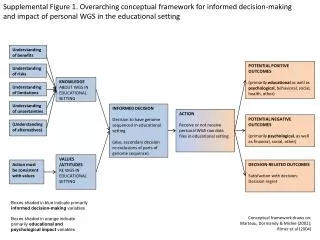
This framework outlines the informed decision-making process regarding personal whole genome sequencing (WGS) in educational settings. It emphasizes understanding the benefits, risks, limitations, uncertainties, and potential outcomes—both positive and negative. The model considers psychological, educational, behavioral, social, and health aspects, highlighting the need for alignment with personal values and attitudes towards WGS. Ultimately, it aims to guide individuals in making informed decisions and understanding the implications of receiving or not receiving WGS data.


Conceptual Framework for Informed Decision-Making in Personal Whole Genome Sequencing Education
E N D
Presentation Transcript
Supplemental Figure 1. Overarching conceptual framework for informed decision-making and impact of personal WGS in the educational setting Understanding of benefits POTENTIAL POSITIVE OUTCOMES (primarily educational as well as psychological, behavioral, social, health, other) Understanding of risks KNOWLEDGE ABOUT WGS IN EDUCATIONAL SETTING Understanding of limitations Understanding of uncertainties INFORMED DECISION Decision to have genome sequenced in educational setting (also, secondary decision re exclusions of parts of genome sequence) ACTION Receive or not receive personal WGS raw data files in educational setting POTENTIAL NEGATIVE OUTCOMES (primarily psychological, as well as financial, social, other) (Understanding of alternatives) VALUES /ATTITUDES RE WGS IN EDUCATIONAL SETTING Action must be consistent with values DECISION-RELATED OUTCOMES Satisfaction with decision; Decision regret Boxes shaded in blue indicate primarily informed decision-making variables Boxes shaded in orange indicate primarily educational and psychological impact variables Conceptual framework draws on: Marteau, Dormandy & Michie (2001); Rimer et al (2004)