Download
1 / 42
420 likes | 553 Vues
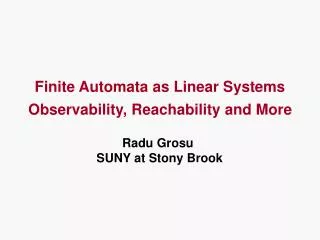
This paper explores the convergence of finite automata and linear systems, highlighting their relationship in control and automata theory. It emphasizes that finite automata can be framed as time-invariant linear systems over semimodules, allowing the application of linear techniques to automata. The discussion includes observability and reachability reductions through linear transformations, exemplifying applications in modeling embedded and biological systems. Notably, techniques such as automata minimization and the "Z"-transform of automata are explored, showcasing the rich interplay between these disciplines.

E N D
Finite Automata as Linear Systems Observability, Reachability and More Radu GrosuSUNY at Stony Brook
Convergence of Theories • HSCC Conference: a witness of the fascinating • convergence between control and automata theory. • Hybrid Automata: an outcomeof this convergence • modeling formalism for systems exhibiting both discrete and continuous behavior, • successfully used to modeland analyze embedded and biological systems.
voltage(mv) Stimulated time(ms) Lack of Common Foundation for HA • Mode dynamics: • Linear system (LS) • Mode switching: • Finite automaton(FA) • Different techniques: • LS reduction • FA minimization • LS & FA taught separately: No common foundation!
Main Conjecture of this Talk • Finite automata can be conveniently regarded as time invariant linear systems over semimodules: • linear systems techniques generalize to automata • Examples of such techniques include: • linear transformations of automata, • minimization and determinization of automata as observability and reachability reductions • “Z”-transform of automata to compute associated regular expression through Gaussian elimination.
b a b a x3 x1 x2 Finite Automata as Linear Systems L1
b a b a x3 x1 x2 Observability L1
b a b a x3 x1 x2 Basis in Boolean Semimodule L1
b a b a x3 x1 x2 Basis in Boolean Semimodule L1
a b a x2 x4 a x1 b b a x3 x5 b b a Observability Reduction by Rows L2
a b a x2 x4 a x1 b b a x3 x5 b b a Observability Reduction by Rows L2
a b a x2 x4 a x1 b b a x3 x5 b b a Observability Reduction by Rows L2
a b a x2 x4 a x1 b b a x3 x5 b b a Observability Reduction by Rows L2
a b a x2 x4 a x1 b b a x3 x5 b b a Observability Reduction by Rows L2
a b a x2 x4 a x1 b b a x3 x5 b b a Observability Reduction by Rows L2
a b a x2 x4 a x1 b b a x3 x5 b b a Observability Reduction by Columns L2
a b a x2 x4 a x1 b b a x3 x5 b b a Mixed Observability Reduction L2
a b a x2 x4 a x1 b b a L2 x3 x5 b b a DFA L21 by rows NFA L22 by columns NFA L23 mixed a a,b b a,b a,b a,b a,b b b b x1 x3 x3 x2 x3 x2 x2 x1 x1 a Original and Reduced Automata L2
a b a x2 x4 a b x1 b a x3 x5 b b L2 a DFA L21 by rows NFA L22 by columns NFA L23 mixed a a,b b a,b a,b a,b a,b b b b x1 x3 x3 x2 x3 x2 x2 x1 x1 Original and Reduced Automata L2 a
a a a a x1 x2 x3 x4 b b b b b x5 x6 x7 L3 a Row Basis but No Column Basis
a a a a x1 x2 x3 x4 b b b b b x5 x6 x7 L3 a Row Basis but No Column Basis
a a a a x1 x2 x3 x4 b b b b b x5 x6 x7 L3 a Row Basis but No Column Basis
a a a a x1 x2 x3 x4 b b b b b x5 x6 x7 L3 a Row Basis but No Column Basis
Observabilty Reduction • Theorem (Cover):Finding a (possibly mixed) basis T • for OL is equivalent to finding a minimal cover for OL. • either as itsset basis coveror asitsKarnaugh cover. • Theorem (Complexity):Determining a cover T for OL • is NP-complete (set basis problem complexity). • Theorem (Rank): The row (= column) rank of OL is the • size of the set coverT (size of Karnaugh cover).
b a b a x3 x1 x2 Reachability: Dual of Observability L1
Observabilty, Reachability and More • DFA Minimization: Is aparticular caseof observability • reduction (single initial state requires distinctness only) • NFA Determinization: Is a particular case of reachability • transformation(take all distinct columns as “basis”) • Minimal automata: Are related by linear maps (but not • by graph isomorphisms!). Better definition of minimality • Other techniques: Are easily formalized in this setting: • Pumping lemma, NFA to RE, Z-transforms, etc.