Understanding Direct Object Pronouns in Spanish Grammar
80 likes | 198 Vues
Dive into the essentials of direct object pronouns (DOPs) in Spanish. These pronouns replace direct object nouns in sentences, making communication more efficient. They answer the questions “whom?” and “what?” regarding the verb. Learn how to correctly use and place DOPs, like "lo," "la," "los," and "las," and get examples to clarify each usage. Understanding DOPs is crucial for mastering sentence structure in Spanish. Enhance your language skills by exploring the roles and placements of direct object pronouns in everyday conversations.


Understanding Direct Object Pronouns in Spanish Grammar
E N D
Presentation Transcript
Direct Object Pronouns Spanish II
DOP • Direct objects receive the action of the verb in a sentence. • They answer the question whom? and what? about the verb • Direct object pronouns take the place of direct object nouns.
English Grammar Connection • Basically, replacing a direct object noun with a direct object pronoun is a way of shorting a sentence. • I have the passport. • I have it. • I am going to pack the suitcases. • I am going to pack them.
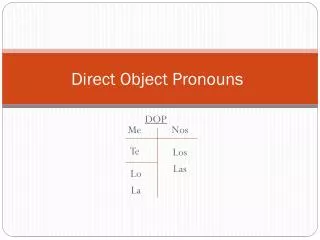
Singular meme te you (inf.) lo him, it, you (m) la her, it, you (f) DOP’s in Spanish Plural nos us os you (inf.) los them, you las them, you
Whom or What? • The pronouns me, te, nos, and os refer only to people. • The pronouns lo, la, los and las can refer to both objects and people.
Whom or what? • Remember that in Spanish the verb ending tell who does the action and the direct object pronoun indicates who receives the action. • ¿Me ayudas, por favor? • Can you help me please?
Placement • Direct object pronouns usually come right before the conjugated verb. • When an infinitive follows a conjugated verb, the direct object pronoun can be placed before the first verb or attached to the infinitive.
Placement • Before the conjugated verb • Veo a la profesora. La veo. • (I see the teacher. I see her.) • Hector tiene el itinerario. Hector lo tiene. • (Hector has the itinerary. Hector has it.) • Tengo los pasaportes. Los tengo. • (I have the passports. I have them.) • Attached to the infinitive • No voy a hacer la maleta hoy. No voy a hacerla hoy.