Download
1 / 7
70 likes | 216 Vues
This text explores the evolution of language from Neanderthals to modern Homo sapiens. Key anatomical changes, such as the descent of the larynx and cranial base adaptations, highlight the development of speech capabilities. It discusses the timeline of hominin evolution, from early australopiths to the emergence of Homo sapiens and Neanderthals, marking significant brain expansions. Additionally, the piece reviews animal communication, referencing studies on vervet monkeys and great apes that illuminate aspects of language evolution and cognitive abilities.

E N D
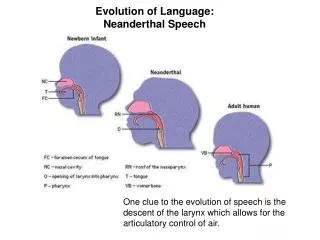
Evolution of Language:Neanderthal Speech One clue to the evolution of speech is the descent of the larynx which allows for the articulatory control of air.
Arch of Cranial Base: Indicates descended larynx • Earliest hominins (Australopiths) had cranial base similar to apes • Cranial base approximates human angle in Kabwe and Steinheim skulls (around 300,000 ybp) • Neanderthal cranium actually flatter than some older samples.
Hominin Evolutionary Chronology • 5-7 mybp: split between chimp and hominin lines • 5-4 mybp: emergence of earliest hominins – australopiths • 2.5-2 mybp: emergence of genus Homo (first major brain size expansion • 1.8 mybp: emergence of Homo erectus/ergaster (first evidence of human-like traits) • .5 mypb: emergence of Homo heidelbergensis (first of the archaic Homo sapiens; second major expansion in brain size • 200,000 ybp: emergence of Homo sapiens, Neanderthals • 35,000 ypb Upper Paleolithic revolution
Animal Language: Vervet Alarm Calls • Different alarm calls appear to be referential
Ape Language Studies • Washoe Koko Nim Chimpsky • Fouts/Gardners Francine Patterson Herb Terrace
Kanzi: The talking BonoboSue Savage-Rumbaugh Lexigram symbol language Simple syntax Spontaneous acquisition Referential/symbolic understanding 90% utterances: requests/commands
Derek Bickerton: Catastrophic Evolution Two steps: protolanguage – associated with increasing brain size Full language – associated with cultural revolution in UP