Exploring Literary Terms: Narrative and Poetry
This guide delves into key literary terms associated with narrative poetry, including essential elements such as plot, conflict, character, and setting. It explains imagery and how it utilizes sensory language to create vivid scenes, as well as the roles of speakers in poems. The guide covers various literary devices like alliteration, rhyme, rhythm, repetition, and irony (verbal, situational, and dramatic), illustrating their significance with examples. This resource is ideal for students and educators aiming to enhance their understanding of poetry and narrative structures.


Exploring Literary Terms: Narrative and Poetry
E N D
Presentation Transcript
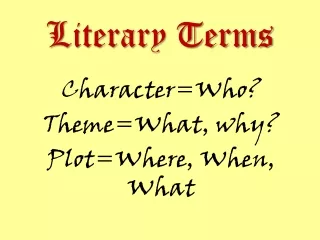
Narrative Poetry • Poetry that consists of the elements of plot, conflict, character, and setting
Imagery • Vivid descriptions that help the reader visualize a scene through the use of sensory language. (5 senses)
Speaker • A voice that talks to the reader in a poem
Alliteration • The repetition of consonant sounds, especially at the beginning of words.
Rhyme • The matching of final vowel or consonant sounds in two or more words
Rhythm • The recurrence of accent or stress in lines of verse. In the following lines from "Same in Blues" by Langston Hughes, the accented words and syllables are underlined: • I said to my baby,Baby take it slow....Lulu said to LeonardI want a diamond ring
Repetition • Repeating the same words or phrases a few times to make an idea clearer
Irony • The contrast between what is expected to happen and what actually occurs. • 3 types: • 1. verbal • 2. situational • 3. dramatic
Verbal Irony • Verbal irony is the use of words to mean something different from what a person actually says. • “Thanks for the ticket, Officer, you just made my day!”
Situational Irony • It involves a discrepancy between what is expected to happen and what actually happens. • There is, however, a difference between situation irony and coincidence or bad luck. • When someone washes his car and it rains, that is just bad luck; nothing led him or her to think that it would not rain. However, when a TV weather presenter gets caught in an unexpected storm, it is ironic because he or she is expected to know the exact weather changes.
Dramatic Irony • Occurs when the audience is aware of something that the characters in the story are not aware of. • In a scary movie, the character walks into a house and the audience knows the killer is in the house.