
Apache Point Observatory Galactic Evolution Experiment: Near-IR High-Resolution Spectroscopy
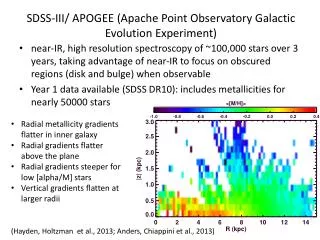
The SDSS-III APOGEE project conducted near-infrared high-resolution spectroscopy of approximately 100,000 stars over three years, focusing on obscured regions such as the disk and bulge of the Milky Way. Year 1 data, available in SDSS DR10, provides detailed metallicity information for nearly 50,000 stars. Findings include flatter radial metallicity gradients in the inner galaxy, variations in gradients above the galactic plane, and steeper gradients associated with low [α/M] stars. Additionally, vertical gradients show flattening at larger radii.

Apache Point Observatory Galactic Evolution Experiment: Near-IR High-Resolution Spectroscopy
E N D
Presentation Transcript
SDSS-III/ APOGEE (Apache Point Observatory Galactic Evolution Experiment) • near-IR, high resolution spectroscopy of ~100,000 stars over 3 years, taking advantage of near-IR to focus on obscured regions (disk and bulge) when observable • Year 1 data available (SDSS DR10): includes metallicities for nearly 50000 stars • Radial metallicity gradients flatter in inner galaxy • Radial gradients flatter above the plane • Radial gradients steeper for low [alpha/M] stars • Vertical gradients flatten at larger radii (Hayden, Holtzman et al., 2013; Anders, Chiappini et al., 2013)
