DNA replication
The discovery of DNA’s structure by Watson and Crick revealed the significance of complementary base pairing in DNA replication. Scientists proposed that DNA "unzips" as hydrogen bonds between base pairs break, allowing new polynucleotide strands to be synthesized from originals as templates. Various hypotheses have been explored regarding the mechanisms of DNA replication, including the Meselson–Stahl experiment. Additionally, the role of replication enzymes and the occurrence of errors leading to gene mutations are pivotal in understanding molecular biology.
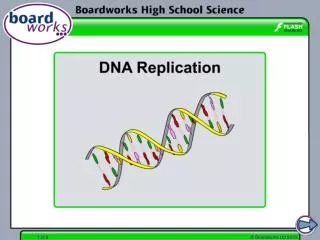

DNA replication
E N D
Presentation Transcript
DNA replication The discovery of DNA’s structure by Watson and Crick provided evidence that complementary base pairing was key to DNA’s ability to replicate. Scientists proposed that DNA “unzipped” as hydrogen bonds between base pairs were broken. New polynucleotide strands could then be synthesized using the originals as a template. Several hypotheses were proposed as to the specific mechanism by which new strands are created.