Understanding the Scientific Method and Basic Science Concepts
Explore the Scientific Method, basic science concepts, and the relationship between science, technology, art, and religion. Learn about Aristotle, Galileo, Copernicus, laws of science, scientific hypotheses, and rounding numbers in physics.

Understanding the Scientific Method and Basic Science Concepts
E N D
Presentation Transcript
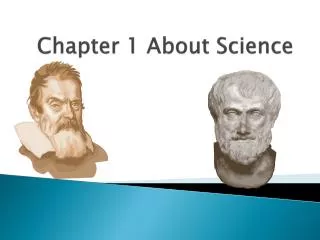
Galileo Movie Definitions • Aristotle-3rd Century BC Philosopher (scientist); believed the Earth was the center of the universe • Aristotelian-a believer in Aristotle’s theory of the universe • Copernicus-16th Century Astronomer; believed the Sun was the center of the universe • Copernican-A believer in Copernicus’ theory of the Universe • Heretic-A person who does not believe in the “established theory” • Inquisition-Trial of a person or group because of their beliefs or lack of
The Basic Science-Physics • The Most Basic Science • About the nature of basic things • Motion, forces, energy, matter, heat, sound, light • Ideas reach up to more complicated sciences • Uses Mathematics to describe and analyze
The Scientific Method • Galileo Galilei (1564-1642) and Francis Bacon (1561-1626) usually credited as creating the scientific method • a method that is effective in gaining, organizing, and applying new knowledge
Scientific Method • Recognize a problem • Make an educated guess (hypothesis) about the answer. • Predict the consequences of the hypothesis. • Perform Experiments to test prediction. • Formulate the simplest general rule that organizes the 3 main ingredients: hypothesis, prediction, experimental outcome.
The Scientific Attitude • Fact-a close agreement by competent observers of a series of observations of the same phenomena • Law-the result of testing a hypothesis over and over and finding no contradictions • Theory-a synthesis of a large body of information that attempts to explain a scientific idea.
Scientific Hypotheses must be testable • In order to be classified as scientific, a hypothesis must be testable. • Must be a test for proving it wrong • Example-Which is a scientific hypothesis? • Atoms are the smallest particles of matter that exist. • The universe is surrounded by a second universe, the existence of which cannot be detected by scientists. • Albert Einstein is the greatest physicist of all time. #1 is considered scientific because there is a test for proving it wrong.
Science, Technology, Art and Religion • Science answers theoretical questions • Technology solves practical problems • Art creates objects that stimulate the senses • Religion deals with nature’s purpose • ALL AREAS ARE COMPLEMENTARY, NOT ANTAGONISTIC (against each other)
Rounding Numbers For EVERY physics problem solved this year, your answer should be rounded at the third number. • If the fourth number (that is not 0) is between 0 and 4, change the 4th number and all remaining numbers to 0. (if they are after the decimal, you can eliminate them) • If the fourth number is between 5 and 9, add 1 to the third number and change the fourth number on to zeros (or delete if after the decimal).
Rounding Practice • Suppose you get the following answers to a physics problem. • 23.4167823 • Look at the fourth number (1) • 1 is between 0 and 4 so delete the 1 and the remaining numbers • Your answer should be 23.4
Rounding Practice • Suppose you get the following answers to a physics problem. • 12,167,823 • Look at the fourth number (6) • 6 is between 5 and 9 so add 1 to the 1 and change the remaining numbers to zeros • Your answer should be 12,200,000
Rounding Practice • Suppose you get the following answers to a physics problem. • .00012376543 • Look at the fourth number not 0 (7) • 7 is between 5 and 9 so add 1 to the 3 and delete the remaining numbers • Your answer should be .000124
Homework • Rounding Practice