Download
1 / 96
960 likes | 1.1k Vues
This overview explores the essential roles of nucleic acids—DNA and RNA—in cellular processes. DNA, predominantly located in the nucleus, serves as the hereditary blueprint, while RNA types (mRNA, tRNA, rRNA, snRNA) play critical roles in protein synthesis and gene regulation. Key concepts include DNA's double-helix structure, the significance of nucleotide composition, and the mechanisms of DNA replication and transcription. Understanding these nucleic acids lays the foundation for grasping molecular biology and genetics.

E N D
DNA and RNA in the Cell Cellular Overview
Classes of Nucleic Acids: DNA • DNA is usually found in the nucleus • Small amounts are also found in: • mitochondria of eukaryotes • chloroplasts of plants • Packing of DNA: • 2-3 meters long • histones • genome = complete collection of hereditary information of an organism
Classes of Nucleic Acids: RNA FOUR TYPES OF RNA • mRNA - Messenger RNA• tRNA - Transfer RNA• rRNA - Ribosomal RNA• snRNA - Small nuclear RNA
THE BUILDING BLOCKS Anatomy of Nucleic Acids
Nucleic acids are linear polymers. Each monomer consists of: 1. a sugar 2. a phosphate 3. a nitrogenous base
Nitrogenous Bases DNA (deoxyribonucleic acid): adenine (A) guanine (G) cytosine (C) thymine (T) Why ? RNA (ribonucleic acid): adenine (A) guanine (G) cytosine (C) uracil (U)
Pentoses of Nucleic Acids This difference in structure affects secondary structure and stability.
Nucleosides linkage of a base and a sugar.
Nucleotides - nucleoside + phosphate - monomers of nucleic acids - NA are formed by 3’-to-5’ phosphodiester linkages
Shorthand notation: • sequence is read from 5’ to 3’ • corresponds to the N to C terminal of proteins
DNA Nucleic Acids: Structure
Primary Structure • nucleotide sequences
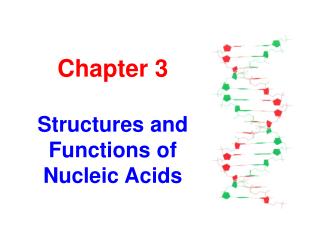
Secondary Structure DNA Double Helix • Maurice Wilkins and Rosalind Franklin • James Watson and Francis Crick • Features: • two helical polynucleotides coiled around an axis • chains run in opposite directions • sugar-phosphate backbone on the outside, bases on the inside • bases nearly perpendicular to the axis • repeats every 34 Å • 10 bases per turn of the helix • diameter of the helix is 20 Å
Double helix stabilized by hydrogen bonds. ATCTGGCAT TAGACCGTA Which is more stable?
A and B forms are both right-handed double helix. A-DNA has different characteristics from the more common B-DNA.
Z-DNA • left-handed • backbone phosphates zigzag
Comparison Between A, B, and Z DNA: • A-DNA: right-handed, short and broad, 11 bp per turn • B-DNA: right-handed, longer, thinner, 10 bp per turn • Z-DNA: left-handed, longest, thinnest, 12 bp per turn
Tertiary Structure Supercoiling supercoiledDNA relaxed DNA
Consequences of double helical structure: • 1. Facilitates accurate hereditary information transmission • Reversible melting • melting: dissociation of the double helix • melting temperature (Tm) • hypochromism • annealing
Structure of Single-stranded DNA Stem Loop
RNA Nucleic Acids: Structure
Secondary Structure transfer RNA (tRNA) : Brings amino acids to ribosomes during translation
ribosomal RNA (rRNA) : Makes up the ribosomes, together with ribosomal proteins.
messenger RNA (mRNA) : Encodes amino acid sequence of a polypeptide
small nuclear RNA (snRNA) :With proteins, forms complexes that are used in RNA processing in eukaryotes. (Not found in prokaryotes.)
DNA Replication, Recombination, and Repair Central Dogma
DNA Replication – process of producing identical copies of original DNA • strand separation followed by copying of each strand • fixed by base-pairing rules
DNA replication is bidirectional. • involves two replication forks that move in opposite direction
DNA replication requires unwinding of the DNA helix. • expose single-stranded templates • DNA gyrase– acts to overcome torsional stress imposed upon unwinding • helicases– catalyze unwinding of double helix • disrupts H-bonding of the two strands • SSB (single-stranded DNA-binding proteins)– binds to the unwound strands, preventing re-annealing
Primer RNA primes the synthesis of DNA. Primase synthesizes short RNA.
DNA replication is semidiscontinuous • DNA polymerase synthesizes the new DNA strand only in a 5’3’ direction. Dilemma: how is 5’ 3’ copied? • The leading strand copies continuously • The lagging strand copies in segments called Okazaki fragments (about 1000 nucleotides at a time) which will then be joined by DNA ligase