Introduction to Artificial Intelligence CS 438 Spring 2008
150 likes | 276 Vues
This introduction to adversarial search in artificial intelligence examines key concepts from AIMA, Chapter 6, with a focus on game-playing agents. It discusses the intriguing nature of games as AI tasks and highlights methods applicable to broader problem-solving. Key themes include search space complexity, real-time decision-making, and learning in dynamic environments, exemplified through historical AI game triumphs such as Deep Blue vs. Garry Kasparov. Additionally, the minimax algorithm is explored, including its properties, time complexity, and the significance of effective evaluation functions in competitive scenarios.


Introduction to Artificial Intelligence CS 438 Spring 2008
E N D
Presentation Transcript
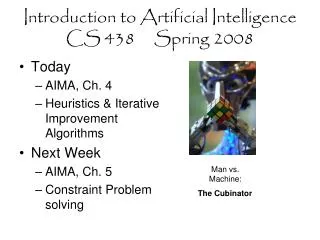
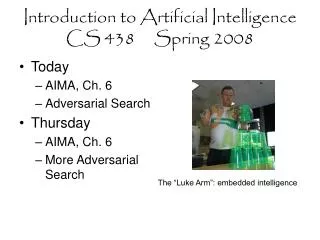
Introduction to Artificial IntelligenceCS 438 Spring 2008 • Today • AIMA, Ch. 6 • Adversarial Search • Thursday • AIMA, Ch. 6 • More Adversarial Search The “Luke Arm”: embedded intelligence
Why is game playing an interesting AI task? • Techniques used in game playing agents can be used in other problem solving tasks • Elements of uncertainty • Search space is too large to look at every possible consequence • Having an unpredictable opponent • Many games have a random element • Real-time decision making • Learning environment
Game Agents vs Human Champions • Chess – Deep Blue • defeated human world champion Garry Kasparov in a six-game match in 1997. Deep Blue searches 200 million positions per second, uses very sophisticated evaluation, and undisclosed methods for extending some lines of search up to 40 ply. • Checkers – Chinook • ended 40-year-reign of human world champion Marion Tinsley in 1994. Used a pre-computed endgame database defining perfect play for all positions involving 8 or fewer pieces on the board, a total of 444 billion positions. • Poker - Polaris • After two thousand hands and countless 'flops', 'rivers', and 'turns', two elite poker players, Phil "The Unabomber" Laak and Ali Eslami, have narrowly defeated Polaris. • Othello - Logistello • Scrabble - Quackle
Two Player Games Optimal Decisions • State Space Definition • Initial state • Board position and an indication of who goes first • Set of operators • All legal moves a play can make • Terminal (goal) test • Test to determine when the game is over • Utility function • Assigns a numeric value for the outcome of the game • Chess: +1 (win), 0 (draw), -1 (loss) • Backgammon: +192 to -192 • For multi-round games
Optimal Decisions • Min Max (minimax) Search • Always assume that your opponent is going to make the move that puts you in the worst possible situation, and conversely improves their own position as much as possible. • best achievable payoff against best play.
Minimax Steps • Generate search tree in depth first manner • Apply utility function to each terminal node • Use utility of terminal nodes to determine the utility of the node above • If the level above is your move (max) choose the maximum value of the leaf nodes • If the level above is your opponents move (min) choose minimum value of leaf nodes • Continue going back-up the tree assigning the utility value to each parent in a similar fashion • Once all of the states have been examined the utility of the best move will be assigned to the root.
Minimax • 4-ply game:
Properties of minimax • Complete? Yes (if tree is finite) • Optimal? Yes (against an optimal opponent) • Time complexity? O(bm) • Space complexity? O(bm) (depth-first exploration) • For chess, b ≈ 35, m ≈100 for "reasonable" games exact solution completely infeasible
Resource limits • A move must be make in a time limit that does not allow the agent to search down to the terminal nodes • Suppose we have 100 secs, explore 104 nodes/sec106nodes per move • Standard approach: • cutoff test: • depth limit (perhaps add quiescence search) • evaluation function: Eval(s) • estimated desirability of position
Evaluation functions • Eval(s) • A numeric value indicating how good the chances of winning the game are from state s • Should be consistent with a utility function for the game • Largest value is a win, lowest value is a loss • Applied to the last level of state expanded • For chess, typically linear weighted sum of features Eval(s) = w1 f1(s) + w2 f2(s) + … + wn fn(s) • Weights are adjusted to improve play or new features could be added.
Hmmm, could you apply a similar idea to the peg board puzzle?