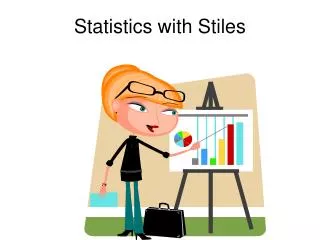
Statistics with Stiles: Intuition vs. Empiricism Explained
Dive into the world of statistics with Stiles as he discusses the concepts of intuition versus empiricism. Learn how to conduct statistical experiments, interpret data using descriptive and inferential statistics, and understand important measures like standard deviation and correlation coefficients. Discover the significance of different types of correlation and gain insights into measurement scales. Join Stiles on a statistical journey that will enhance your understanding and application of statistical strategies.

Statistics with Stiles: Intuition vs. Empiricism Explained
E N D
Presentation Transcript
Hello Favorite Class! Write down the number of pennies I can drop into the cup at the front of the room without spilling any water.
Intuition vs. Empiricism • Intuition- understanding without apparent effort, quick and ready insight seemingly independent of previous experiences or empirical knowledge. (gut feeling) • Empiricism emphasizes the role of experience and evidence .
Let’s Test This Statistical Strategy! • Find a Partner • Decide who is going to be the experimenter and who will be the subject • Experimenter will need to take out a folder or a book to hide important information from the subject. • Calculate how often you won when you switched.
Descriptive Summarizes a set of data, makes it easy to interpret. %, averages r = correlation coefficient Standard Deviation Inferential Allows us to make decisions or reach conclusions about data. Statistically Significant or Chance? (p < .05) The probability of an event occurring by chance is less than 5%. Descriptive vs. Inferential
Measures of Central Tendency • Mode- most frequent • Median- middle most • Mean- average of set scores • Frequency distributions-(organized list) • Can be misleading, know which measure of average is being used. Positive/Negative Skew ?
Measures of Variability • Range- difference in high/low • Standard Deviation- square root of variance (measure of variance from the mean) • Packed together or dispersed?
Using Standard Deviation to your Advantage!Top 10 Rushing Leaders (2000)
Ranked Order of Rushers • Who is the most consistent? • Davis • Who is the most erratic? • Dillon
Correlations (Co-relation) • r = -1.0 (strong negative correlation) ↑↓ • r = +1.0 (strong positive correlation) ↑↑ or ↓↓ • 0 = No Correlation • Correlation coefficients help us determine the direction and strength of a relationship. • Correlation does NOT imply causation!! • Correlations may be used to predict!
Identify each of the scatter plots.r = -.99 r = -.7 r = 0 r = -.3 r = .5 r = .9 Scatter Plot A Scatter Plot B Scatter Plot C Scatter Plot D Scatter Plot E Scatter Plot F
Basic Stats-Measurement Scales • Nominal (name, categorize) • Ordinal (serial position) • Interval Scale (temperature) • Ratio Scale (weight)