Download
1 / 23
230 likes | 347 Vues
This presentation highlights the role of GEF Focal Points in Monitoring and Evaluation (M&E) during a Sub-Regional Workshop held in Auckland, New Zealand, on September 18-19, 2008. It emphasizes the importance of systematic data tracking and the evaluation process to improve project outcomes in Pacific Small Island Developing States (SIDS). Key topics include tracking national portfolios, utilizing tools and approaches for M&E, participation of focal points in various evaluations, and fostering collaboration among stakeholders to ensure effective project implementation and alignment with national development goals.

E N D
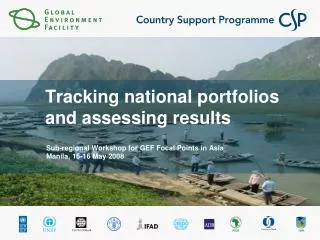
Tracking national portfolios and assessing results Sub-Regional Workshop for GEF Focal Points in the Pacific SIDS Auckland, New Zealand, 18-19 September 2008
Presentation Outline • Monitoring & Evaluation • Role of Focal Points in M&E • Tracking the Portfolio: Tools & Approaches • Role of M&E in implementation of the RAF • OPS4 • Monitoring: Issues for Discussion
What is Monitoring & Evaluation? • Monitoring provides management with a basis for decision making on progress and GEF with information on results. This involves: • Ongoing, systematic gathering of qualitative and quantitative information to track progress on project outcomes & outputs • Identification of implementation issues and propose actions to solve these • Evaluation provides lessons learned and recommendations for future projects, polices and portfolios. This involves: • Periodic assessment of results (i.e. outputs, outcomes and impact) according to the criteria of relevance, effectiveness, efficiency and sustainability
Relevance of Monitoring & Evaluation for Focal Points: →Monitoring: • Project Implementation Review (for each project annually) • Portfolio Monitoring (country specific) →Evaluation: • Mid-Term Evaluation of projects (in some cases – and often called a review) • Terminal Evaluations – of all projects • Portfolio Evaluations by country (e.g. Vietnam, China)
Role of GEF Focal Point in M&E… Role depends on country specific circumstances → - Country capacity Institutional setting Portfolio scope and size (number of projects) What are some of the potential roles and responsibilities in M&E? Keeping track of GEF support at the national level Keeping stakeholders informed and consulted in plans, implementation and results of country GEF M&E activities Disseminating M&E information, promoting use of evaluation recommendations and lessons learned, particularly in new project proposals Assisting the Evaluation Office, as the first point of entry into a country, during evaluations: identifying major relevant stakeholders, coordinating meetings, assisting with agendas –coordinating country responses to these evaluations Other examples?
Key Message 1: It is very important for Focal Points to participate in and be informed of Monitoring and Evaluation in their countries.
Key Message 2: There is no prescribed role for the Focal Points in Monitoring and Evaluation – it depends in the institutional setting, capacity and portfolio scope, size.
Tracking the Portfolio: Tools and Approaches M&E of the portfolio: Creating a simple tracking system for GEF projects (see next slide) Including the GEF Support in national tracking system of international grants/loans Reporting GEF achievements against national development goals and objectives (MDGs? Reporting to Conventions?) Establishing a close collaboration with GEF Agencies M&E officer and projects managers Exchanging experiences and information in workshops – both sub-regional and national Supporting annual workshops to discuss project implementation, experiences and lessons and results with key GEF players in the country
Tracking the Portfolio - an example • Basic Data – such as: • Project Data (name, agency, focal area etc.) • Financial information: GEF grant and cofinancing • Project cycle dates (entry into pipeline, approval, start up) • Basic data can be found in the PMIS • Substantive Data – such as: • Objective(s), Expected Outcome(s), • Ratings: implementation progress and likelihood of achieving objectives, • Once completed: actual achievements and lessons learned, • Substantive data can be found in project documents • This information feeds into the progress of overall environmental achievements at higher levels, namely: the national targets, the MDGs and the GEF strategic targets. • Keep it simple and only collect and record information that will be used!
Tracking the portfolio: Why is it useful? • Tokeep track of environmental achievements towards national targets, the MDGs and the GEF strategic targets and mandate • To improve coordination and policies / institutions: • For national coordination of the GEF portfolio: between ministries, implementing and executing agencies, civil society etcetera • To feed into national decision making on GEF support (strategy, priorities) • For harmonization purposes: preventing overlap between donors, agencies, government policies and so on • To improve project implementation: • To provide an overall overview of the GEF portfolio currently under implementation in the country • To be informed of implementation progress and help resolve implementation issues of projects (start, end, major events, delays) • To be able to address common problems – reoccurring in the portfolio • To integrate lessons learned, disseminate valuable experience and give recommendations in future work/ project proposals
Where to find information to track the portfolio? • Project Implementation Reports produced annually by the projects and GEF Agencies (self assessments) • Supervision reports from GEF Agencies • PMIS (project management information system)
Role of M&E in implementation of the RAF M&E is linked to improving results and performance which is linked to countries RAF allocations: • To improve Global Environmental Benefits (GEB) • of projects • at country level → RAF GBI • To improve environmental policies and institutions • through projects • at country level → RAF GPI
Tracking the portfolio: Why is it useful? (2) (continued) • To improve project results • increase global environmental benefits • ratings of projects in terminal evaluations → RAF GPI • To improve project implementation • increase likelihood of project results • Ratings in project implementation reports → RAF GPI
Key Message 3: Monitoring & Evaluation is linked to improving results and performance - which is linked to countries RAF allocations…
OPS4 • See separate presentation • Focal points who have a solid understanding of the GEF support in their country will be able to provide a substantial input into OPS4 • ops4@thegef.org
Monitoring: Issues for discussion • How are the partners working together in monitoring? (Focal Point, Agency, project staff, technical ministry or department, beneficiaries…) • Who does what? How is information circulating? How can the Focal Point support the GEF portfolio in national management and decision-making? • Further development of tools for tracking portfolios. • How are available tools used? • What type of information is required? How will the information be used? • Who should be involved in national knowledge sharing forum? And how?
Available information sources: • Project evaluations: mid-term and final (independent) from GEF Agencies • National development goals tracking systems • Knowledge exchange during workshops(national coordination committees, with other focal points, annual workshops with implementing / executing agencies, other actors in the field – NGOs, CBOs etc) • Information from established focal area task forces, networks, environmental assessments and other relevant activities. • Evaluations conducted by GEF-EO and independent evaluation offices of GEF Agencies
More information…. • GEF corporate evaluations and lessons learned: www.gefeo.org, under Publication or Ongoing Evaluations • The GEF M&E Policy: www.gefeo.org, under Policies and Procedures • Project evaluations (161 terminal evaluations): www.thegef.org, under Project Database, for search click on Evaluation Documents • Email contact: gefevaluation@theGEF.org