Download
1 / 18
180 likes | 304 Vues
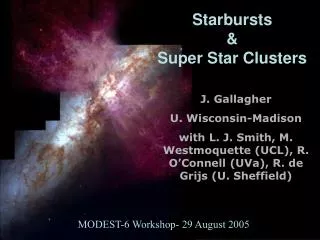
This study explores the fascinating phenomenon of extreme starbursts in nearby galaxies, utilizing data from the Hubble Space Telescope (HST). Key focus areas include the age and mass of star clusters, star formation histories, and the influence of galaxy interactions. By employing broad-band and narrow-band imaging, we analyze cluster populations in M.83, NGC 3077, and NGC 5253. Our findings reveal the significant roles of ionization, mechanical heating, and feedback processes in starburst environments, contributing to our understanding of the interstellar medium and the dynamics of star formation.

E N D
Studying Nearby Starbursts with HST • Jason Harris (Steward Observatory) • Daniela Calzetti, Jay Gallagher, Denise A. Smith, & Christopher Conselice Extreme Starbursts :: Lijiang Aug 2005
Star Clusters Interstellar Medium Detailed look at the starburst phenomenon Nearby Starburst Galaxies • Age and Mass estimates • Star formation history; duration and duty cycle • Role of interactions • Cluster IMF; specific frequency; dissolution • Ionization and mechanical heating • Feedback and chemical enrichment • Outflows and infall Extreme Starbursts :: Lijiang Aug 2005
Cluster Populations in Starburst Galaxies • Broad-band HST imaging • of 3 nearby starbursts • (F300W, F547M, F814W) • Constrain age and mass of each cluster M 83 NGC 3077 NGC 5253 Extreme Starbursts :: Lijiang Aug 2005
What happens to a cluster as is ages? Extreme Starbursts :: Lijiang Aug 2005
What happens to a cluster as is ages? Extreme Starbursts :: Lijiang Aug 2005
If cluster colors can be measured accurately, their ages can be determined The two-color diagram What happens to a cluster as is ages? Extreme Starbursts :: Lijiang Aug 2005
The Challenge of Cluster Photometry • Star/cluster classification requires exquisite angular resolution, even for nearby starbursts • Starburst galaxies typically suffer heavy extinctionincomplete sampling • Cluster populations are often highly crowdedmakes aperture photometry extremely difficult • Cluster sizes are variablemakes profile-fitting photometry extremely difficult • Galaxy backgrounds can be highly variablemakes any photometry more difficult Extreme Starbursts :: Lijiang Aug 2005
Aperture Photometry vs. Profile-Fitting Photometry: a hybrid approach The Challenge of Cluster Photometry Extreme Starbursts :: Lijiang Aug 2005
Neighbor-cleaned Aperture Photometry Identify groups of non-crowding objects; remove all other objects for “clean” aperture photometry Extreme Starbursts :: Lijiang Aug 2005
Extinction from Hα/Hβ NGC 3077 NGC 5253 Extreme Starbursts :: Lijiang Aug 2005
From Photometry to Mass and Age Starburst99 population synthesis models (Leitherer et al. 1999) Extreme Starbursts :: Lijiang Aug 2005
Cluster Mass & Age Distributions Extreme Starbursts :: Lijiang Aug 2005
Interstellar Medium M 83 NGC 3077 NGC 5253 Narrow-band HST imaging: [OIII], Hα, [SII] Extreme Starbursts :: Lijiang Aug 2005
Hα Morphology M 83 NGC 3077 NGC 5253 Extreme Starbursts :: Lijiang Aug 2005
Ionization Diagnostics log( [SII] / Hα ) M 83 NGC 3077 log( [OIII] / Hβ ) NGC 4214 NGC 5253 log( [SII] / Hα ) log( [SII] / Hα ) Photoionization models by Kewley et al. (2001) Extreme Starbursts :: Lijiang Aug 2005
Mapping the “shock” ionization 200 pc 430 pc 410 pc M 83 NGC 3077 NGC 5253 Black pixels are “non-photoionization” regions Extreme Starbursts :: Lijiang Aug 2005
Results & Implications •Non-photoionized (shocked?) Hα emission accounts for ~ 3%-4% of total emission, ~15%-25% by area. •Starbursts in dwarfs deposit 70%-100% of mechanical energy in surrounding ISM (within 0.2-1 kpc); may result in propagating star formation • Amount of “shocked” gas in dwarfs implies SF duration >> 30 Myr (consistent with cluster/diffuse stellar ages) •The starburst in the giant spiral M 83 deposits ~35%-75% of its mechanical energy in the ISM. The shocks are localized in ‘bubbles’ (no extended shells):confined starburst Extreme Starbursts :: Lijiang Aug 2005
Summary • Study star-formation processes in nearby starburst galaxies • Broad-band imaging: • clusters formed on timescale of few x 107 yr • in NGC 5253, no clusters older than 20 Myr...efficient destruction? • very few “Super” star clusters • Narrow-band imaging: • non-photoionization accounts for only a few percent of Hα luminosity • most mechanical energy output from SNe deposited in ISM • non-photoionized regions in M 83 imply confined starburst Extreme Starbursts :: Lijiang Aug 2005