Advancements in Cryogenic Dark Matter Search (CDMS) at Soudan: Progress and Future Directions
100 likes | 230 Vues
Since last summer, the Cryogenic Dark Matter Search (CDMS) has made significant strides at the Soudan facility, conducting successful operations with five towers and ongoing data collection. The transition to SuperCDMS at SNOLAB aims for a massive upgrade, increasing target mass to 25 kg while reducing background noise. Key enhancements include improved cryogenics, robust electronics, and better detector configurations ensuring high efficiency and real-time data analysis capabilities. The goal is to improve sensitivity dramatically and explore potential WIMP signals as we approach the future of dark matter research.


Advancements in Cryogenic Dark Matter Search (CDMS) at Soudan: Progress and Future Directions
E N D
Presentation Transcript
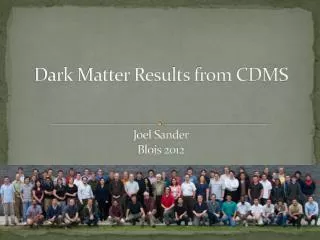
Cryogenic Dark Matter Search (CDMS) Progress at Soudan since last summer Successful run with 5 towers Prospects at Soudan Continued data taking with 5 towers (4 kg Ge) The Future - SuperCDMS at SNOLAB Larger target mass (25 kg) and lower backgrounds
Cryogenic and Detector Upgrades • Cryogenics Upgrades • Better vacuum to improve stability, decrease maintenance • Better control and monitoring, more robust against power outages (UPS and generator installed) • Improve cooling at 4K with cryocooler on electronics stem; reduce Lhe consumption, costs; had to deal with vibration problems • Detectors • Three new towers installed (each with 6 detectors); total of 4.5 kg Ge, 1 kg Si • Thermal connections to refrigerator improved
Commissioning of the 5 Tower SystemJuly-September 2006 • Detector Tuneup • Optimize SQUID, TES settings • Neutralize crystals with LEDs • LOTs of calibration data • DAQ and online analysis • Handle 80 Hz calibration rate • Robust data pipeline to surface • Near realtime analysis for data quality monitoring • Electronic noise reduction • Systematic work to eliminate unnecessary grounding • Eliminate a few strong sources of RF (cordless phones) • Reduce 60 Hz harmonics
Data run with 5 towersOctober 2006 - March 2007 • Vital statistics • Base temperature (40 mK) for ~ 9 months • 5 months of high-efficiency data taking (430 kg-days Ge) • 107.4 live days for WIMP search (2.7 million events) • 36 million gamma calibration events • 0.76 million neutron calibration events • 4 TB of data • Blind analysis underway • Cuts set using calibration data • Expect to open nuclear recoil region this summer • Present results at fall conferences • Sensitivity should be at least x3 better than present
First Five Tower Run Summary Maximum livetime = 85% (limited by cryo servicing need for calibration data) Published CDMS results Current sensitivity Average livetime ~ 75%
A short break for maintenance • Warmed up to 4K in mid-March • Serviced vacuum pumps, clean 3He/4He mixture • Eliminated partial obstruction in dilution unit • Successfully back to base temperature by end of March • Addressing some low-level electronics noise (60 Hz harmonics) • Minor detector retuning; new triggers • Backup power completed Underground diesel generator to maintain cryogenics Large UPS to backup electronics
Second data run with 5 towersApril 2007 - April 2008 • Aim for another x3 improvement in sensitivity (~1200 kg-d) • Combined x10 better than present limits • Or perhaps we might start to see signal • May start to run into backgrounds at Soudan in 2008 • Beta backgrounds on some detectors • Neutrons from cosmic rays • If background-free, run 5 towers into 2009 • Possible to insert first two SuperCDMS towers in 2009
The Future of CDMS at Soudan DAMA ZEPLIN-1 Edelweiss SUSY Models CDMS II - Published Good chance that a WIMP signal begins to appear here! Current sensitivity CDMS II -projected
SuperCDMS 25 kg at SNOLAB • Cosmic-induced neutron background will appear at Soudan • SNOLAB is x3 deeper; no fast neutrons • SNOLAB available in early 2008 (DUSEL much later) • Further reductions in backgrounds necessary • Whole lab is class-2000 cleanroom at SNOLAB • Increase detector mass by x6 (4 ---> 25 kg) • Improved volume to surface (reduce surface backgrounds) • Entire detector mass will be Ge (Si no longer needed) • Improved design for cryogenics system • Cryocoolers allow cryogen-free dilution refrigerators! • Considerably cheaper to operate, less maintenance • Goal is x15 improvement in sensitivity • We hope to be exploring a WIMP signal by then!