Download
1 / 10
100 likes | 221 Vues
The Advancing Digitization of Biodiversity Collections (ADBC) project, led by the University of Florida and supported by NSF, aims to improve access to biodiversity data for researchers, policymakers, and the public. With participation from over 150 institutions nationwide, ADBC promotes efficient digitization of natural history collections and fosters collaboration to address environmental and economic challenges. Key initiatives include ten Thematic Collections Networks (TCNs) focusing on various ecosystems and species. This effort harnesses over 3 billion biodiversity specimens to support research and education on critical issues like climate change and species conservation.

E N D
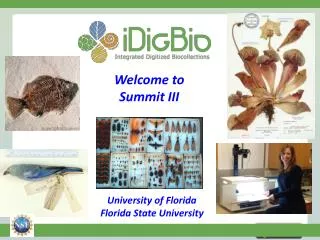
Welcome to Summit III University of Florida Florida State University NSF EF-1115210
Advancing Digitization of Biodiversity Collections (ADBC) National center for activities related to digitization of institutional natural history collections
Advancing Digitization of Biodiversity Collections • Facilitate use of biodiversity data to address environmental and economic challenges • Researchers • Educators • General public, citizen scientists • Policy-makers • Develop efficient and effective digitization standards and workflows • Respond to cyberinfrastructure needs • Develop research, education and outreach collaborations • Plan for long-term sustainability of the national digitization effort
Ten Thematic Collections Networks (TCNs) • InvertNet:An Integrative Platform for Research on Environmental Change, Species Discovery and • Identification (Illinois Natural History Survey, University of Illinois) • Plants, Herbivores, and Parasitoids: A Model System for the Study of Tri-Trophic Associations • (American Museum of Natural History) • North American Lichens and Bryophytes: Sensitive Indicators of Environmental Quality and Change (University of Wisconsin – Madison) • Digitizing Fossils to Enable New Syntheses in Biogeography-Creating a PALEONICHES-TCN (University of Kansas) • The Macrofungi Collection Consortium: Unlocking a Biodiversity Resource for Understanding Biotic Interactions, Nutrient Cycling and Human Affairs (New York Botanical Garden) • Mobilizing New England Vascular Plant Specimen Data to Track Environmental Change (Yale University) • Southwest Collections of Arthropods Network (SCAN): A Model for Collections Digitization to Promote • Taxonomic and Ecological Research (Northern Arizona University) • The MacroalgalHerbarium Consortium: Accessing 150 Years of Specimen Data to Understand Changes in the Marine/Aquatic Environment (University of New Hampshire) • Developing a Centralized Digital Archive of Vouchered Animal Communication Signals (Cornell University) • Fossil Insect Collaborative: A Deep-Time Approach to Studying Diversification and Response to • Environmental Change (University of Colorado at Boulder)
134 institutions in 49 states Ten TCNS and collaborating institutions: 152 institutions in 50 states
Biodiversity Collections The single largest source of information on biological diversity (outside nature) is our natural history collections. 1,600 – 2,500 natural history collections 3 billion specimens globally 1 billion specimens in USA
Biodiversity Collections The single largest source of information on biological diversity (outside nature) is our natural history collections. 1,600 – 2,500 natural history collections 3 billion specimens globally 1 billion specimens in USA
iDigBio: Workshops and Working Groups,Establishing Connections, andCyberinfrastructure • 22 workshops and symposia (about 1/month) • >500 participants from >150 institutions • Representation at another ~20 events • Established relations with other collections organizations and biodiversity initiatives • CollectionsWeb • iPlant • NESCent • NEON • AIBS • SPNHC • NSCA • USGS/BISON • COLLABIT • ---nets
Collections for the 21st CenturyA symposium sponsored by iDigBioand Natural Science Collections Alliance • May 5-6, 2014 • University of Florida, Gainesville • Goals: • Emphasize the value of collections data in meeting grand challenges facing biodiversity and human society • Demonstrate that value to policy-makers, administrators, others who determine the levels of support for collections …. the next step • Topics will include uses of taxonomic, spatial and temporal data on biodiversity • to address questions related to human health, climate change, food security, etc., • as well as more fundamental investigations related to biological diversification.
Opportunities • New research and education initiatives • One billion records – huge source of biodiversity data • Opportunities for previously intractable large-scale research requiring large amounts of spatial and temporal data Big-science questions related to human health, climate change, agriculture, species discovery, species extinctions, rates of evolutionary change, and ecosystem services