Uganda's Journey Since Independence (1962-2002): A Comprehensive Overview
80 likes | 281 Vues
This presentation by Jane Egau Okou, Ph.D. Candidate in Workforce Education & Development, provides an insightful analysis of Uganda's political, economic, and educational developments from independence in 1962 to 2002. Covering Uganda's historical context, including its colonial past, political transformations, and significant growth in literacy and school enrollment due to government initiatives, the discussion highlights the challenges and successes that shaped the nation. With a focus on cultural aspects and the vital role of education for girls, this presentation aims to inform and inspire.


Uganda's Journey Since Independence (1962-2002): A Comprehensive Overview
E N D
Presentation Transcript
UGANDA SINCE INDEPENDENCE (1962-2002) Presentation at Center for Adult Learning and Literacy Jane Egau Okou Ph.D Candidate, Workforce Education & Development April 2003
About Myself • Born from a peasant family of 11 kids • Married with 2 children (5 and 9) • My husband is a university lecturer • I am a Senior Education Officer, MOES • First came as a Humphrey Fellow in 2001 • Currently a Ph.D student in WFED
Background • Located in the Eastern Part of Africa • Bordered by Rwanda, Burundi, Tanzania, Kenya, Sudan, and Congo. • It is a landlocked country • It has a population of 24.6 million • Land size is about 240,000 sq miles
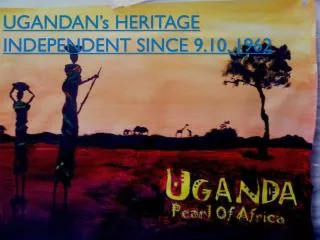
Political History • Was a British colony from 1898 – 1962 • Gained independence 9-10-1962 • Six presidents have ruled since then • Worst years in history – (1971-1979) • Currently stable in most parts of the country • Not very good external relations with Rwanda and DRC.
Economy • Wars affected seriously economy • Among the poorest countries in the world • Good economic policies at present • Very rich in natural resources. • Predominantly agricultural economy • Currently growing at about 6% per year
Education • Education system is 7-4-2-(3-5) years • Traditionally education was for boys • Top priority of government at present • Literacy rates improved from 35% to 65% • School enrolment increased from 2.3- 7 m children due to UPE program • Education of girls has become significant
Culture • Marriage practices • Dress codes • Food • Character