Intermolecular Forces and Their Effects on Properties
Explore the different types of intermolecular forces and their impact on various properties such as boiling point, melting point, viscosity, vapor pressure, and surface tension.


Intermolecular Forces and Their Effects on Properties
E N D
Presentation Transcript
Intermolecular Forces Microscopic Properties Rule the Macroscopic World
What causes them? • Two things affect intermolecular forces: • Charge • Distance • Bigger distance equals LESS attraction! • More charge equals MORE attraction! • Coulomb’s Law • F ~ charge/distance2 • Distance has more effect since it is squared.
IMF’s versus Bonds • Bonds are permanent attractions, IMF’s are temporary
Types of Bonds • Covalent • Sharing of electrons in permanent tug of war. • Ionic • Stealing electrons and then being attracted by opposite charges
Types of IMF’s • Ion Dipole • Hydrogen Bonding • Dipole-Dipole • London Dispersion forces
Ion Dipole Interactions • Between an ion and a dipole! • Ion = permanently charged particle • Dipole = a polar molecule • Almost exclusively seen in aqueous solutions.
Dipole-Dipole Interactions • Between two dipoles! • Dipoles are polar molecules that have no net charge, but the charge is distributed unequally. • Positive end of one attracts negative end of the other.
London Dispersion Forces • ALL covalent compounds experience this force. • It is between the electrons in one atom and the nucleus of another atom. • More mass and/or more atoms means more dispersion forces.
Be Very Careful! • More mass doesn’t cause an increase in LDF! • More mass infers that there are more P and N, which MEANS there are more electrons. • It is an increase in the number of e- which causes a larger e- density which leads to a stronger temporary dipole. • You can use molar mass to figure it out since a larger molar mass implies a bigger density but you can't use the words molar mass in your justificationin a Free Response Question
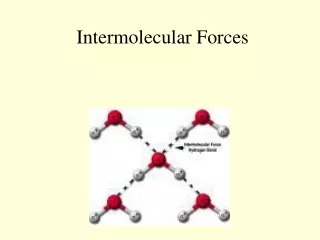
Hydrogen Bonding • Occurs in molecules in which hydrogen is having FON! • The most electronegative atoms are F, O and N. With a hydrogen, there is excessive polarization. • This excessive polarization attracts the lone pair of electrons.
Strengths of IMF’s • Strongest: Ion-Dipole (very strong) Hydrogen Bonding (strong) Dipole-Dipole Dispersion Forces (very weak)
Effects of IMF’s • More IMF’s or stronger IMF’s affect the following properties: • Boiling point • Melting Point • Viscosity (thickness) • Vapor Pressure • Surface tension
Boiling Point • Stronger IMF • Higher boiling point • Weaker IMF • Lower boiling point • Compare CS2 to CO2
CS2 to CO2 Both are linear Both are nonpolar covalent Both have LDF CS2 has stronger LDF – larger molecule means larger e- density
Melting Point • Stronger IMF • Higher melting point • Weaker IMF • Lower melting point • Think of red rover… • Compare HBr to Cl2
HBr to Cl2 • Both are liner • HBr has LD, Dipole • Cl2 has LD, nonpolar • HBr has stronger IMF – higher melting point
Viscosity • Stronger IMF • Higher viscosity • Weaker IMF • Lower viscosity • More attached to each other, the hard to flow, like solids vs. liquids. • Compare CH3OCH3 to CH3CH2OH
CH3OCH3 to CH3CH2OH CH3OCH3 LD, Dipole CH3CH2OH LD, HB Therefore CH3CH2OH has stronger IMF and a higher viscosity
Vapor Pressure the pressure exerted by a vapor, particularly a vapor in contact with its liquid form • Stronger IMF • Lower vapor pressure • Weaker IMF • Higher vapor pressure • Again…think red rover. • Compare H2S to H2O2
H2S to H2O2 • H2S LD, Dipole • H2O2 LD, HB • H2O2 has stronger IMF therefore lower vapor pressure
Surface Tension • Resistance of a liquid to increase in its surface area • Stronger IMF • Higher surface tension • Weaker IMF • Lower surface tension • Compare H2CO to H2O
H2CO to H2O • H2CO LD, Dipole • H2O LD, HB • Hydrogen bonding is a stronger IMF than Dipole, therefore H2O has a stronger surface tension
Summing it Up • Stronger IMF • Higher boiling point • Higher melting point • Higher viscosity • Higher surface tension • Lower vapor pressure • Weaker IMF • Lower boiling point • Lower melting point • Lower viscosity • Lower surface tension • Higher vapor pressure