Download
1 / 16
170 likes | 288 Vues
This overview of Classical Greece (ca. 500-323 BC) explores the era's significant military conflicts and cultural achievements. The formation of the Greek League united city-states against the Persian threat, leading to the eventual defeat of Persia. However, internal strife during the Peloponnesian War saw Athens and Sparta clash, resulting in Athens' decline. The leadership of Macedonian kings Philip II and his son Alexander the Great marked a critical shift, as they expanded their empire while promoting Greek ideals across conquered lands. Discover the interplay of warfare, art, and philosophy in shaping ancient history.

E N D
Intro Era of Warfare Greek League Empire of Athens Civil War Two Macedonians Leaders Greek Ideals Spread/ Theater & Art Key Terms Persian War Peloponnesian War Philip Alexander Classical Greece(ca. 500-323 BC)
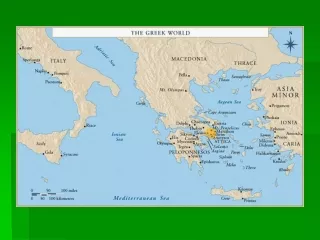
Persian Wars (490-479 BC) • Previously, there had been very little cooperation between different Greek city-states, but... • Persian Empire threatened all Greek city-states.
Greek League(490-474 BC) • Unified 31 different Greek city-states against Persia. • Sparta was chosen to lead & Athens provided navy & much of the wealth. • Cooperation led to defeat of Persian Empire. Thermopylae (480 BC)
Empire of Athens(450 BC) • Following Persia’s defeat Athens tried to dominate other city-states.
Peloponnesian War (431-404 BC) • Greek Civil War: Several Greek city-states (including Sparta) united to fight Athens. • Eventually the Athenians were defeated
One Macedonian King • Conquered several Greek city-states. • Forced all to accept him as their leader by 337 BC. • He was murdered in 336 BC. Philip II (382-336 BC)
Macedonian Phalanx The 18 foot long wooden pikes & smaller shields revolutionized infantry warfare
A Second Macedonian • Became king of Macedonia after his father’s death. • A military genius: • Conquered Persia & Egypt • Encouraged intermarriage • Created the largest empire in the ancient world, allowed Greek ideas to spread eastward. Alexander The Great (356-323 BC)
Greek Theater, Art & Philosophy • 500-323 BC Greek culture = Golden Age
Seats At The Theater Luxury box; higher back & armrest
Philosophy & Ideas • Wrote Hippocratic Corpus concerning medical ethics & theories. • Today: Hippocratic Oath Hippocrates (ca. 460-ca. 377 BC)
Greek Philosophers • Mathematician & Philosopher • Believed the entire universe could be explained using math/numbers Pythagoras (6th century BC)
Greek Philosophers • An influential teacher in Athens (Socratic Method) • Did not believe in Olympian Gods & questioned EVERYTHING • Found guilty of corrupting youth & committed suicide by drinking poison Socrates (469-399 BC)
Intro Era of Warfare Greek League Empire of Athens Civil War Two Macedonians Leaders Greek Ideals Spread/ Theater & Art Key Terms Persian War Peloponnesian War Philip Alexander Hippocrates Pythagoras Socrates Classical Greece(ca. 500-323 BC)