Download
1 / 10
100 likes | 207 Vues
This report presents a preliminary analysis of gap triggers utilized in Run II, focusing on specific triggers like JT_25TT_Gap and their performance. The analysis, conducted by Andrew Brandt and reviewed by Michael Strang, underscores the differences between GapN and GapS events in terms of energy and jet distribution. Initial findings indicate that gap events may exhibit lower energy in the forward region with fewer jets as compared to inclusive samples. The results necessitate further investigation into trigger efficiency and data selection methods to enhance the understanding of gap phenomena.

E N D
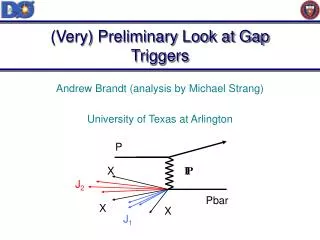
(Very) Preliminary Look at Gap Triggers Andrew Brandt (analysis by Michael Strang) University of Texas at Arlington P X I P J2 Pbar X X J1
Gap Triggers • There are several dedicated gap triggers in the Global DØ trigger list (Gap triggers first added in V7.4, reached current form in V8.2 after problems with CJT(3). • JT_25TT_Gap {CJT(2,5) L3JET(1,25)} • JT_25TT: Requires 2 calorimeter jet towers at level 1 with ET above 5 GeV. At Level 3, a jet above 25 GeV with simple cone algorithm • Gap: Can be GAPN (-h, pbar-side), GAPS (+h, Pside), GAPSN (both) or NG (no gap required) • Starting to look at data to determine what Run II gaps look like (preliminary analysis on special run failed due to corrupted cal chunk) • Also have zero_bias_Gap triggers for this study • Mike Strang (diffractive jets) and Tamsin Edwards (double pomeron) and Pavel Demine working on defining a rapidity gap for RunII • Compare diffractive jets to inclusive jets • From Run I, expect Gap events to be quieter (less energy in forward region), with fewer and narrower jets than inclusive sample
North vs. South Rates • We have observed a difference in rate between GapN and GapS (higher) at Level 1. For trigger list 8.2: (note cross sections not Begel-approved) L1(mb)L3(mb) prescale NG 10.0 3.57 220 GapN 0.07 0.03 2 GapS 0.70 0.25 8 GapSN 0.01 0.01 1 • Would expect GapS and GapN to be equivalent, GapN appears closer to expectations, needs to be studied
Data Selection • Run 165008 (V8.3), reconstructed with p11.12.01; 4 hours at low (~10e30) luminosity • Applied standard event quality cuts • |pvtx| < 50. cm • nvtx = 1 for now • Esum (cells > 100 MeV) < 2 TeV • Events with 1 jet: • mET < 0.7 * jet.pt[0] • Applied standard jet quality cuts and looked at jets > 15 GeV • 0.05 < EMF < 0.95 • CHF < 0.4 • HotF < 10. • n90 > 1. • f90 < -.05 * CHF + 0.8 where f90 = n90 / nitm
Cal Energy Comparison E >2.5 (S) E <-2.5 (N) GapS GapS E <-2.5 (N) E >2.5 (S) GapN GapN Energy correlations as expected for GapN, but GapS is contaminated
NG energy vs. opposite side E >2.5 (S) E <-2.5 (N) E >2.5 (S) E <-2.5 (N) NG NG GapN GapS Good gap events (GapN) have lower energy on non-gap side than NG
Leading Jet ET NG GapN GapS GapSN Jets have similar ET distributions
NJets (GapN vs. NG ET > 15 GeV) Gap-like events have less jets
Jet Width (GapN vs. NG) NG GAPN Gap-like events have narrower jets
Summary • Gap triggers are providing useful data, but GapS term is contaminated by large fraction of non-Gap events. - Could be due to timing of GapS and/or term (most likely) - Could be due to inefficiency of LM counters on South side Further study required (quick look by Rich inconclusive— need time from Begel) • Look at Zero Bias data to define gap (set thresholds) • Move to more recent data, large stats • Request lower prescale on JT_25TT_GapN trigger, balanced by higher prescale on GapS. Will be using GapN trigger for FPD AFE commissioning