Structural Stiffness & Strength Goals for OCE2 Launch Configuration
Recommended stiffness and strength goals for generic spacecraft and launch vehicle encompassing fundamental frequencies, load limits, factors of safety, and optimization suggestions. Attention to detector array and on-orbit structure stability assessment.

Structural Stiffness & Strength Goals for OCE2 Launch Configuration
E N D
Presentation Transcript
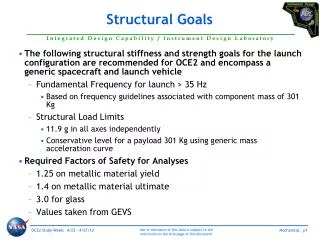
Structural Goals • The following structural stiffness and strength goals for the launch configuration are recommended for OCE2 and encompass a generic spacecraft and launch vehicle • Fundamental Frequency for launch > 35 Hz • Based on frequency guidelines associated with component mass of 301 Kg • Structural Load Limits • 11.9 g in all axes independently • Conservative level for a payload 301 Kg using generic mass acceleration curve • Required Factors of Safety for Analyses • 1.25 on metallic material yield • 1.4 on metallic material ultimate • 3.0 for glass • Values taken from GEVS
Structural Analysis Recommendations • Since the spacecraft for OCE and launch vehicle have not yet been defined, recommend using the generic stiffness goals and structural loads defined on the Structural Goals page • The design will likely need significant optimization, particularly the cradle assembly and trunnion connection to instrument housing • Detector array structure stiffness should be >50 to reduce risk of coupling to overall instrument modes • On-orbit configuration will also need to be assessed for stiffness and stability due to thermal loads and s/c and self-induced disturbances. • Particular attention should be paid to potential coupling between on-orbit structure modes and the momentum compensator 24.6 Hz rotation rate.