
1 / 13

Enhancing Mathematics Scores Through Mastery Learning and Constructivist Approaches

This program aims to improve student mathematics scores by equipping teachers with the necessary beliefs, skills, and materials. By implementing a mastery learning philosophy, it emphasizes the importance of concrete, semi-concrete, and abstract learning within genuine contexts. Teachers will utilize various methods such as direct instruction, guided practice, and assessments to help students achieve mastery. The curriculum incorporates individualized instruction, small group rotations, and the utilization of both formative and summative assessments, allowing each student to discover concepts meaningfully.
sage-finch
Télécharger la présentation

Enhancing Mathematics Scores Through Mastery Learning and Constructivist Approaches

An Image/Link below is provided (as is) to download presentation Download Policy: Content on the Website is provided to you AS IS for your information and personal use and may not be sold / licensed / shared on other websites without getting consent from its author. Content is provided to you AS IS for your information and personal use only. Download presentation by click this link. While downloading, if for some reason you are not able to download a presentation, the publisher may have deleted the file from their server. During download, if you can't get a presentation, the file might be deleted by the publisher.

E N D

Presentation Transcript


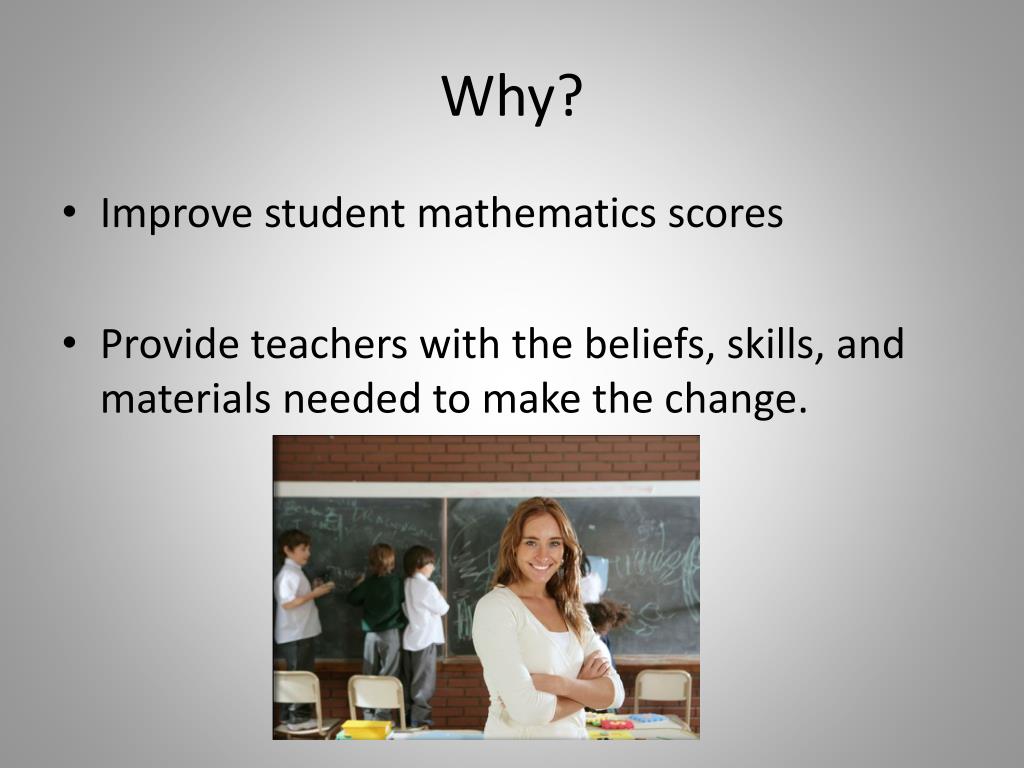
  1. Why? • Improve student mathematics scores • Provide teachers with the beliefs, skills, and materials needed to make the change.

  2. What?Laying the Foundation • Philosophy: (Beliefs) • Mastery Learning (Less is More) (David Coleman) • Concrete, Semi-Concrete, Abstract • Within a genuine context (meaningful) • Constructivist—Discovery Learning • Using Mistakes as teaching points • Multiple Avenues to get to the same place

  3. What?Skills—Mastery Learning • Tracking • Pre and Post Tests • Formative and Summative Assessments • Individualized Instruction • Computerized • Small group rotation model • Curriculum Compacting

  4. What—Teaching Methods? • Instructional sequence • Direct Instruction, Guided Practice, Independent Practice • Instructional Content • 3 Concrete, 3 semi-concrete, then abstract for all grade levels

  5. What—Teaching Context? • Genuine Context • School and home application • Useful extensions • Constructivism • Each student given the opportunity to come to discovery on their own.

  6. What--Content • Basic Facts (Fluency) • Concepts • Problem-Solving • High-level understanding • Algorithms and Multiple Paths—set of instructions to describe a process. (i.e., adding fractions)

  7. How--Philosophy • Constructivist Math • Marilyn Burns http://mathsolutions.com/ • Other? • Contextualized Math • Connected Math http://www.phschool.com/cmp2/ • Grades 6-8 • Needs supplemental with problem-solving • Authentic Needs • Playground refurbishing • Cooking • Opportunities at home and school

  8. How—Recommended sources • Ma. L. Knowing and Teaching Elementary mathematics: Teachers' Understanding of Fundamental mathematics in China and the United States.  1999.  New York: Routledge. • Elementary mathematics for Teachers.  Parker & Baldridge • http://www.singaporemath.com/Elementary_Mathematics_for_Teachers_p/emft.htm

  9. How? • Mastery Learning--Tracking • Core Content—What to use? • GA-Cumberland Tests? www.flconfcurriculum.wikispaces.com • Common Core Standards? http://www.corestandards.org/the-standards/mathematics/grade-1/operations-and-algebraic-thinking/ • Less is More: http://www.usatoday.com/news/education/2008-03-13-math-panel_n.htm • GA-Cumberland Key Learning Tests • Pre (Use previous year at beginning of school year) • Post (Use current year at end of school year) • Accountability factor? Form from GA-Cumb • Submit on wiki? • Progress Monitoring • Sprints. Differentiated Math timed tests from Singapore math • Monitoring Basic Skills Progress by Lynn S. Fuchs, Carol L. Hamlett, Douglas Fuchs • 2 minutes for concepts (second grade) • 8 minutes for applications (second grade) • New DIBELS tests (Math section)

  10. How? • Individualized Math Content to move forward from baseline (What level is this on: concrete, semi-concrete, abstract? Implications?) • Khan Academy www.khanacademy.com • Appropriate grade levels? • ST Math http://www.mindresearch.net/ • Cost prohibitive? • Conference-wide initiative? • Pilot schools first? • IXL http://www.ixl.com/math/ • Comparison with Khan • Venn Diagram for grade levels • Effectiveness compared to Khan • Fluency Practice for Math Facts • Program recommended by Dream Lake Elementary? • Also necessitates keyboard training • Free online programs? Must include timing, tracking element for fluency • Accelerated Math?

  11. How—Conceptual Understanding • Algebra • Hands-on-Equations www.borenson.com • 4-8 initiative • Problem-solving • Singapore strategies www.singapore.com • 1-4 initiative to begin? • Break up into K-2 and 3-4? • Instructional strategies • Concrete, semi-concrete, abstract Mercer and Mercer • Direct, GP, IP, taped sessions from FL Conf teachers

  12. What If? • How can we perpetuate the model when the Fl Conf hires about 35 new teachers each year? • Online modules with links to resources and video-taped presentations? • Tracking system for teachers? • Professional Portfolios in classroom? • All teachers trained to understand math up to grade 8?

  13. Next • Assignments: • Anna and Valmae: Fluency and Progress Mon. • Debbie: ST Math • Kari and Stephen: Khan Academy vs. IXL math • James: Authentic Math, Connected Math, read about Constructivism in teaching math (See: Marilyn Burns) • Claudette and Frances: Math Rotations • Sandy: Tracking and Core Body of Material • Almibar: Call Southern Math Dept and make some connections with professors to see how we might work with them as a team • Next meeting: Math Webinar, August 1, 2 – 4 p.m. • Fall Inservices: To plan during next webinar

More Related