Download
1 / 15
150 likes | 298 Vues
This text delves into the methodologies behind inferring phylogenetic relationships among species. It emphasizes the importance of shared derived traits, inherited from common ancestors, for understanding evolutionary history. The concepts of homology, convergent evolution, and trait adaptation are explored. The discussion includes how the identification of ancestral and derived states can clarify evolutionary relationships, as well as the role of outgroups in rooting trees. The utility of parsimony in constructing phylogenies is also highlighted.

E N D
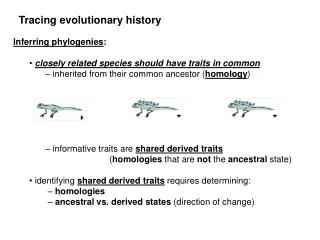
Tracing evolutionary history • Inferring phylogenies: • closely related species should have traits in common • – inherited from their common ancestor (homology) • – informative traits are shared derived traits • (homologies that are not the ancestral state) • identifying shared derived traits requires determining: • – homologies • – ancestralvs. derived states (direction of change)
outgroup – provides information about ancestral state – roots the tree Which traits are ancestral? Which traits are derived?
3 possible trees – what changes are implied? – which traits are informative? – which tree is best? LH parsimony – fewest changes SM E SM SM E LH LH SM SM E
Use parsimony to build a phylogeny: outgroup? homologies? ancestral vs. derived states? shared derived traits? eggshells four limbs backbone
Tracing evolutionary history • Inferring phylogenies: • closely related species should have traits in common • – inherited from their common ancestor (homology) • – informative traits are shared derived traits • (homologies that are not the ancestral state) • complications arise when traits are shared for other reasons • – convergent evolution • – reversal to the ancestral state
convergence – trait adapted to similar function but with a different origin
Shared traits 1) Homology – inherited from common ancestor
Shared traits 1) Homology – inherited from common ancestor 2) Convergent evolution – similar adaptations
long head? • hair? • smile? • ears? • nose? LH LH LH
long head? • hair? • smile? • ears? • nose? H SM N LH H – shared derived trait H – convergence SM E N H SM N H LH LH H H N SM E SM E N
Same pattern can reflect different evolutionary histories convergent evolution of hair reversal to hairless H – convergence H – reversal OR H LH LH H H N N SM SM E E H
0 0 1 1 2 2 3 3 4 4 1 A . . . . 2 C G G . . 3 G . . . . 4 C . . . . 5 G . A T T 6 G . . . . 7 T . . C C 8 C . . . . 9 A . . . . 10 T . . A . 11 T . . . . 12 A . . . . DNA base A(5) A(10) sp 0 sp 1 sp 2 sp 3 sp 4 G(2) T(5) C(7) T(12) 1 A . . . . 2 C G G . . 3 G . . . . 4 C . . . . 5 G . T T T 6 G . . . . 7 T . . C C 8 C . . . . 9 A . . . . 10 T . . A . 11 T . . . . 12 A . . . . 12 A T T T T T(5) G(5) sp 0 sp 1 sp 2 sp 3 sp 4 G(2) T(5) C(7) T(5) Phylogenetic analysis of molecular data 12 A T T T T
What are phylogenies good for? • Tracing evolutionary relationships • e.g.: disease transmission (problem set 4) • coevolution (in text) • tree of life • classification • adaptive radiation
Evolutionary relationships – classification Should birds be distinct from reptiles?