Atom Model History
Explore the fascinating evolution of atomic theory, beginning with Democritus in Ancient Greece, who first proposed that atoms are the smallest particles of matter. Learn about John Dalton's contributions in 1803, including the idea that atoms cannot be created or destroyed. Discover J.J. Thomson's "Plum Pudding" model, which introduced electrons, and Ernest Rutherford's discovery of the atomic nucleus. Finally, delve into quantum developments by Niels Bohr and Erwin Schrödinger, who advanced our understanding of electron behavior and atomic structure.

Atom Model History
E N D
Presentation Transcript
Atom Model History Where did it all begin?
What is an atom? The smallest particle of an element that can keep the same properties of the element. What is the smallest number of carbon atoms that have all of the properties of carbon? One
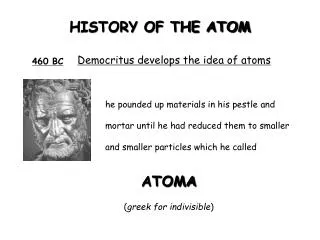
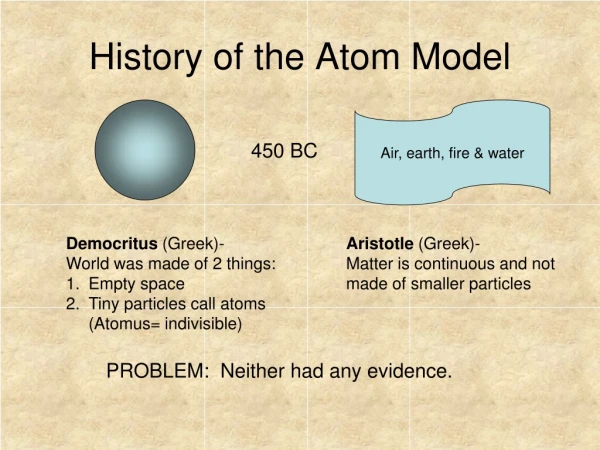
Democritus(Ancient Greece, 440 B.C.) He stated that atoms are the smallest particles of all matter. Who was the first person to use the word atom? Democritus
Dalton(1803) • He proposed that atoms: • are the smallest part of matter. • cannot be created, divided, or destroyed. • of the same element are alike. (H = H) • of different elements are different. (H is not O.) • join to make new substances. (H + H + O = H20) Did Dalton discover all five of these ideas? No, he proposed (suggested) them.
Thomson(1897) • Discovered electrons • “Plum Pudding” Model: atom is a lump of positively charged matter with electrons scattered throughout (like chocolate chip cookie dough.) Did JJ Thompson discover protons? No, he just suggested positive matter.
Rutherford(1902) • Discovered atoms have a nucleus (small, dense, positively-charged center) • Atoms are mostly empty space • Solar System Model How is this model like a solar system? It has objects (electrons) moving around a central point (nucleus).
Bohr (1913) • Said electrons move around the nucleus at certain speeds. Did Mr. Bohr know that electrons moved? How? Yes, because of Rutherford’s research.
Schrodinger (1920’s) • Said electrons are in “clouds” around the proton- and neutron- filled nucleus. • Said the “clouds” have different amounts of energy. What is Schrodinger’s first name? Erwin
Heisenburg1927 • Said where the electron clouds could exist in the atom. • Argued a lot with Schrodinger.. Was Heisenburg a student of electrons? Yes he was.
Helpful Websites • http://www.broadeducation.com/htmlDemos/AbsorbChem/HistoryAtom/page.htm • http://www.csmate.colostate.edu/cltw/cohortpages/viney/atomhistory.html • http://www.nobeliefs.com/atom.htm
Lab Outline • http://www.integratelearning.org/Lesson%20Bank/AMcGinley/lp1pp1_files/frame.htm