Distribution Strategies for Scarce Antidotes in a Dreaded Disease Scenario
In this thought-provoking scenario, we explore how to allocate a limited number of antidotes to combat a deadly disease affecting children on an island. With 1,000 children and 1,000 available doses, we must act quickly to minimize mortality rates, which vary significantly based on the number of doses administered. We analyze the impact of scarcity on decision-making and distribution methods, including command and free-market approaches. This exercise highlights the intersection of economics with public health, emphasizing strategies that benefit both families and pharmaceutical companies.

Distribution Strategies for Scarce Antidotes in a Dreaded Disease Scenario
E N D
Presentation Transcript
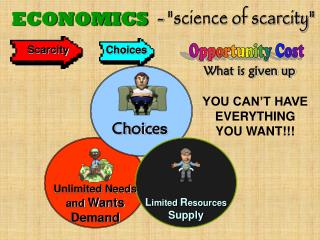
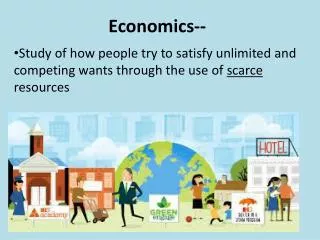
Study of how people try to satisfy unlimited and competing wants through the use of scarce resources Economics--
Dreaded Disease Scenario You are on an island that is periodically struck by a “dreaded disease” the affects only children. You know the disease strikes randomly and affects 80% of the island’s child population. There is a preventative antidote that reduces the chance of death if taken before the disease strikes. • 0 doses of antidote= 90% chance of dying • 1 dose of antidote= 10% chance of dying • 2 doses of antidote= 8% chance of dying • 3 doses of antidote= 6% chance of dying • 4 doses of antidote= 5% chance of dying • After 4 doses, there is no further effects…remains 5% d/r Suppose there are 1000 children on the island with 1,000 available doses. Need to act immediately… HOW ARE YOU GOING TO GIVE OUT THE DOSES?
Solutions • How does “scarcity” effect situation? • Consider the different market methods…command, free-market, equal? • What is the best method of distributing for the most people? • Benefits for families? For pharmaceutical companies? • This is economics
Exit Slip • In your own words, compose a definition to the term “economics” • Consider everything we have learned today and the mind set needed to think this way • I will collect, put your name on paper