Enhancing Learning by Reducing Cognitive Overload in Educational Technology
Explore the impact of cognitive overload in educational technology and learn how to improve learning experiences by leveraging cognitive load theory. This session covers types of cognitive load, practical applications, and resources for effective integration of Web 2.0 technologies.

Enhancing Learning by Reducing Cognitive Overload in Educational Technology
E N D
Presentation Transcript
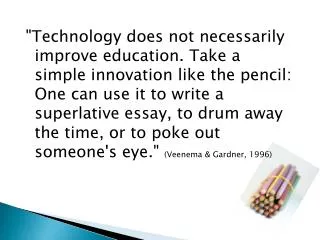
"Technology does not necessarily improve education. Take a simple innovation like the pencil: One can use it to write a superlative essay, to drum away the time, or to poke out someone's eye." (Veenema & Gardner, 1996)
Reducing Cognitive Overload: Jennifer J. Little, MLS, Reference/Instruction Librarian, The College at Brockport, State University of New York, jlittle@brockport.edu Anne M. Canale, MS CDIT, Independent Consultant, Instructional Design, Instructional Technology and E-learning, annemcanale@gmail.com Effective Integration of Web 2.0 Technologies Ed Tech Day 2010, Ithaca College, Ithaca, NY March 25, 2010
Why do we care? • Instructional professionals need to know if Web 2.0 technologies support or disrupt learning. • New technologies • which ones support learning? • which ones trends-fads, the “bells & whistles”? • How do we create learning experiences that reduce CO, thus enhancing and improving learning?
What is Cognitive Overload? • One’s cognitive capacity for learning is limited; often called information overload. • Often obvious: • Poorly designed • Disorganized • Irrelevant/redundant information • Aesthetically unappealing • Distracting; noisy; busy • Poor use of font/color/style
Types of Cognitive Load • Intrinsic - amount of cognitive processing required to comprehend the material • Germane (relevant)- learner engaged in making sense of the material using familiar/new schema. • Extraneous (irrelevant)-amount of cognitive capacity used for cognitive processing is not relevant to the goals of instruction; does not contribute to learning (Mayer, 2008)
Cognitive Load Theory • Learning principles - result in efficient instructional environments as a consequence of leveraging human cognitive learning processes. • Universal – all types of content, all delivery media, all learners. • Application-use fundamental tools of training (text, visuals, audio, technical content, soft skills); design; incorporate into all delivery platforms (print/online)
"Technology does not necessarily improve education. Take a simple innovation like the pencil: One can use it to write a superlative essay, to drum away the time, or to poke out someone's eye." (Veenema & Gardner, 1996)
Resources • http://cognitiveloadandweb20.pbworks.com/FrontPage