Understanding Isosceles, Equilateral, and Right Triangles
110 likes | 255 Vues
This lesson focuses on the properties and theorems related to isosceles, equilateral, and right triangles. An isosceles triangle has at least two congruent sides, known as the legs, with the non-congruent side as the base. The angles opposite the legs are congruent (Base Angles Theorem), and vice versa (Converse of the Base Angles Theorem). We also explore the relationships in equilateral triangles where all sides and angles are equal. Additionally, we discuss right triangles and the Hypotenuse-Leg (HL) Congruence Theorem, which states that congruency can be established through specific leg and hypotenuse measurements.


Understanding Isosceles, Equilateral, and Right Triangles
E N D
Presentation Transcript
4.6 Isosceles, Equilateral, and Right Triangles Standard 5.0 Goal: Use properties of isosceles, equilateral, and right triangles
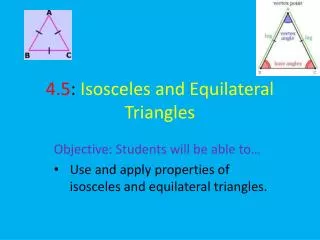
Goal 1: Using Properties Of Isosceles Triangles • In Lesson 4.1, you learned that a triangle is isosceles if it has at least two congruent sides, then they are the legs of the triangle and the non congruent side is the base. The two angles adjacent to the base are the base angles. The angle opposite the base is the vertex angle.
Theorems • Theorem 4.6 Base Angles Theorem: If two sides of a triangle are congruent, then the angles opposite them are congruent. • If AB = AC, Then <B = <C
Theorem 4.7 • Converse Of the Base Angle Theorem: • If two angles of a triangle are congruent, then the sides opposite them are congruent. • If <B =<C, then AB =AC
Example #1 proof of the Base Angles Theorem • Given: ∆ABC, AB =AC • Prove: <B=<C
Corollaries • Corollary To theorem 4.6 • If a triangle is equilateral, then it is equiangular. • Corollary To Theorem 4.7 • If a triangle is equiangular, then it is equilateral.
Example #2 • Using Equilateral and Isosceles Triangles • 3x=180 • X=60
Theorem Theorem 4.6 Hypotenuse-Leg (HL) Congruence Theorem If the hypotenuse and a leg of a right triangle are congruent to the hypotenuse and a leg of a second right triangle, then the two triangles are congruent.
Example # 3 Proving Right Triangles Congruent • Given: AE EB, AE EC • AE ED, AB =AC =AD • Prove: AEB = ABC = AED • Solution • Paragraph Proof You are given that