Multi-Scale Quantum-Mechanical Modeling of Chemo-Mechanical Phenomena in Real Materials
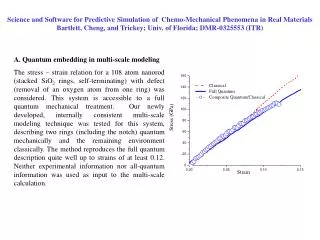
This study presents a novel multi-scale modeling technique for predicting chemo-mechanical behaviors in materials. We focus on a 108-atom nanorod composed of stacked SiO2 rings, analyzing its stress-strain relationship under a quantum mechanical framework. Notably, we examine a defect scenario involving the removal of an oxygen atom, demonstrating our method's capability to reproduce full quantum behavior up to strains of 0.12 without relying on experimental data. The research integrates contributions from Ph.D. students and showcases broader outreach through student presentations at various conferences.

Multi-Scale Quantum-Mechanical Modeling of Chemo-Mechanical Phenomena in Real Materials
E N D
Presentation Transcript
Science and Software for Predictive Simulation of Chemo-Mechanical Phenomena in Real Materials Bartlett, Cheng, and Trickey; Univ. of Florida; DMR-0325553 (ITR) A. Quantum embedding in multi-scale modeling The stress – strain relation for a 108 atom nanorod (stacked SiO2 rings, self-terminating) with defect (removal of an oxygen atom from one ring) was considered. This system is accessible to a full quantum mechanical treatment. Our newly developed, internally consistent multi-scale modeling technique was tested for this system, describing two rings (including the notch) quantum mechanically and the remaining environment classically. The method reproduces the full quantum description quite well up to strains of at least 0.12. Neither experimental information nor all-quantum information was used as input to the multi-scale calculation.
Science and Software for Predictive Simulation of Chemo-Mechanical Phenomena in Real Materials Bartlett, Cheng, and Trickey; Univ. of Florida; DMR-0325553 (ITR) Education Multi-scale modeling is modular, involving the prior solution to several fundamental problems in materials research (e.g., potential parameterization, quantum embedding). The results here represent the synthesis of completed Ph. D. research of DeCarlos Taylor (student of R.J. Bartlett) and Aditi Mallik (student of J.W.Dufty), and the undergraduate research of Neesha Anderson (also with Dufty). Dr. Taylor is now at the U.S. Army Research Laboratory, Weapons and Materials Research Directorate, Dr. Mallik has recently joined the materials group at Intel, and Ms. Anderson is a senior Physics major at the University of Florida. Outreach The pair potentials parameterized for this system have been applied to different silica structures that are the focus of studies by other groups in the US and Europe. The results have been exchanged with these groups for broader applications. Student presentations were given at: APS Annual March Meeting, March 21, 2005; Sanibel Symposium, March 6 - 11, 2005; SESAPS Meeting, Nov, 2004; NSF DMR ITR Computational Workshop, UIUC, June, 2004 ; Sanibel Symposium, Feb 28 - Mar 3, 2004; REU Program, UF,Feb 12, 2004; Department of Physics, IIT Kanpur, Jan 12, 2004.