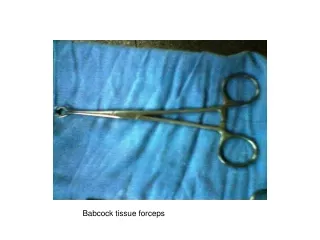
Forceps
AzeeMed's Forcep offers a broad range of surgical benefits. Its Ideal use is to manipulate blood vessels and control haemostasis to prevent surgical complications For this purpose, the instrument includes a pair of jaws with delicate transverse serrations that prevent endothelial damage.


Forceps
E N D
Presentation Transcript
Understanding Different Types of Forceps in Surgery Forceps are one of the most essential surgical instruments used across various medical specialties. These precision tools are designed to grasp, hold, manipulate, and retract tissues, needles, and other surgical materials. Available in numerous shapes and sizes, forceps cater to specific surgical needs, ensuring optimal performance during procedures. From delicate microsurgery to complex general surgeries, forceps play a crucial role in improving surgical efficiency and patient outcomes. Classification of Surgical Forceps
Forceps can be broadly categorized into two types: non-locking (thumb forceps) and locking (clamp forceps). Thumb forceps are used in a tweezer-like manner and require continuous pressure to hold objects. Locking forceps, also known as hemostatic forceps or clamps, have a ratchet mechanism that allows them to hold onto tissues or vessels without constant pressure from the surgeon’s hand. Thumb forceps include instruments like Adson forceps, which are commonly used in delicate surgeries, and DeBakey forceps, which are ideal for cardiovascular procedures. Locking forceps, on the other hand, include instruments like Kelly forceps and Crile forceps, which are used for hemostasis, clamping blood vessels to control bleeding during surgery. Commonly Used Surgical Forceps Among the various forceps used in surgery, some are particularly well-known for their specialized functions. Adson forceps are frequently used in plastic surgery and general procedures, offering a secure grip on delicate tissues. Their fine, serrated tips allow for precision handling without crushing the tissue. Similarly, Brown-Adson forceps feature multiple small teeth along the gripping surface, making them suitable for handling tissues with more grip control. Another widely used forceps type is the Halsted Mosquito forceps, which are small, fine-tipped instruments used to control bleeding in delicate procedures. These are particularly useful in pediatric surgeries and ophthalmic procedures. Meanwhile, Allis forceps have interlocking teeth and are designed to firmly grasp tissues, making them ideal for holding structures like fascia or skin during dissection. Specialized Forceps for Specific Surgical Fields Different surgical specialties require forceps with specific designs to cater to their unique needs. In cardiovascular surgery, DeBakey forceps are the instrument of choice due to their long, fine tips that can grasp delicate vessels without damaging them. For neurosurgical procedures, Bayonet forceps provide a unique angled shape, allowing surgeons to work around delicate neural structures with precision and minimal obstruction. In gynecology, ring forceps such as Foerster forceps are used for holding gauze or tissues during procedures. Meanwhile, dressing forceps like Adson dressing forceps are frequently used to hold sterile materials and assist in wound care management. Importance of Choosing the Right Forceps The selection of forceps in surgery is crucial for ensuring procedural success and minimizing tissue damage. The right forceps provide the necessary grip and precision required for a specific task, reducing the risk of trauma to delicate structures. Additionally, ergonomic designs help reduce hand fatigue for surgeons, allowing for greater control and efficiency in long procedures. Conclusion
Forceps are an indispensable tool in surgery, available in a vast range of designs to accommodate different medical procedures. From general surgeries to specialized fields like neurosurgery and cardiovascular surgery, each type of forceps plays a crucial role in enhancing surgical precision. Understanding their variations and applications allows surgeons to choose the appropriate instrument for optimal patient outcomes.












![FORCEPS [SURGICOSE]](https://cdn4.slideserve.com/8057002/medical-instruments-medical-instruments-dt.jpg)