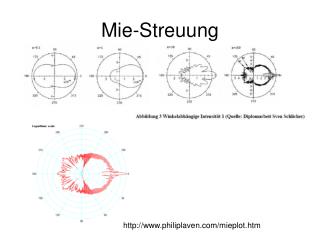
Mie Calculations of Gold-Shell Cavity Modes in a Silica Medium
80 likes | 204 Vues
This study explores the electromagnetic cavity modes of a gold (Au) shell with a core radius of 228 nm and a total radius of 266 nm within a silica medium. Utilizing the Finite Difference Time Domain (FDTD) method, we characterize the cavity modes at 700 nm and 880 nm, investigating on-resonance and off-resonance excitations. Key parameters such as quality factor, maximum field enhancement, and mode volume are analyzed. The tunability of cavity modes with shape alterations is also discussed, providing insights for future photonic applications.


Mie Calculations of Gold-Shell Cavity Modes in a Silica Medium
E N D
Presentation Transcript
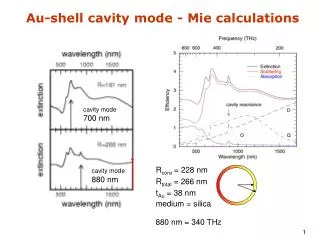
Au-shell cavity mode - Mie calculations Rcore = 228 nm Rtotal = 266 nm tAu = 38 nm medium = silica cavity mode 700 nm cavity mode 880 nm 880 nm = 340 THz 1
Finite Difference Time Domain method ky Ex Step 1: Excitation Step 2: Relaxation Step 3: Fourier Transform Plane wave excitation on and off resonance stores some energy in particle Fast Fourier transform of the relaxation E(t) to generate frequency spectrum Particle oscillates, reemitting at its resonance frequency 2
Snapshots- Au shell (R=266 nm, tAu = 38 nm) in silica box (1.5x1.5 μm2) +2 +1 Ex 0 -1 -2 excitation off-resonance at 150 THz (2 μm) E-field monitor in center 335 THz (895 nm) Fast Fourier Transform p=1.3x10¹⁶ rad/s =1.25 x10¹⁴ rad/s d=9.54 3
Snapshots- Au shell (R=266 nm, tAu = 38 nm) in silica box (1.5x1.5 μm2) +2 +1 Electric field intensity max= 6.5 at center 5 Ex 0 cavity mode! -1 0 excitation on-resonance at 335 THz (895 nm) -2 excitation off-resonance at 150 THz (2 μm) 4
Cavity parameters • Quality factor Q=35 • The maximum field enhancement within the core amounts to a factor of 6.5 • The mode volume V=0.2 (/n)3 … 102-103 smaller thanthan that in micordisc/microtoroid WGM cavities • A characteristic Purcell factor – assuming homogeneous field distribution in the cavity core and =895 nm
Cavity optimization A characteristic Purcell factor assuming homogeneous field distribution in the cavity core, =895 nm and Q=150:
Cavity mode is tunable - T-matrix vs FDTD calculations Penninkhof et al, JAP 103, 123105 (2008) 7
Cavity mode is tunable by shape -oblate Au shell spheroid T / 240 THz L / 410 THz aspect ratio=2.5 8