Download
1 / 32
320 likes | 444 Vues
This presentation discusses the concept of Enhanced Publications and the significance of linking scholarly works to underlying data for improved research outcomes. It showcases the DFG project ECO4R led by hbz Cologne, emphasizing the use of Semantic Web technologies to create machinereadable links between publications and data. The talk highlights the challenges of representing complex structures in repositories and explores pragmatic approaches for making scholarly resources more discoverable and reusable. It also touches on existing vocabularies, ontologies, and future developments in linked data compliant publishing systems.

E N D
This talk • About „Enhanced Publications“ • Links between Publications andunderlyingdatasignificantforresearchconduct • About „Compound Objects“ • Focused, activityfor Germany • DFG project ECO4R ledbythehbz Cologne • Usingsemantic web aspragmatictool
and partly complex structures – not represented appropriately…
Enhanced Publications • Precious, existingpatternsofscholarlyresourcestobe ‚liberated‘ forre-use • Currentlynowaytosystematicallyrepresentthesepatternsforre-use • Expressing „expectations“ ofhumans • Concepts!!!
Semantic Web / LOD a possible way to represent enhanced publications? • Yes • machinereadable web-representationofcompoundobjects • No • datamissing • not designedfor human concepts • serviceprovidersaremissing
Eco4R – an exploration activity • How to support existing concepts in human reasoning? • How to make opaque or unstructured content in existing repositories (rather than catalogues) visible and re-usable? • focus Germany (OpenAIRE and Netherlands not shown here) • Which existing vocabularies and ontologies can be re-used? • What could be linked to other existing LOD data sources? See also: „Report on Enhancing Interoperability between existing Open Access Publication Infrastructures“
Eco4R Approach Services Enhanced Publications Machines Humans Data
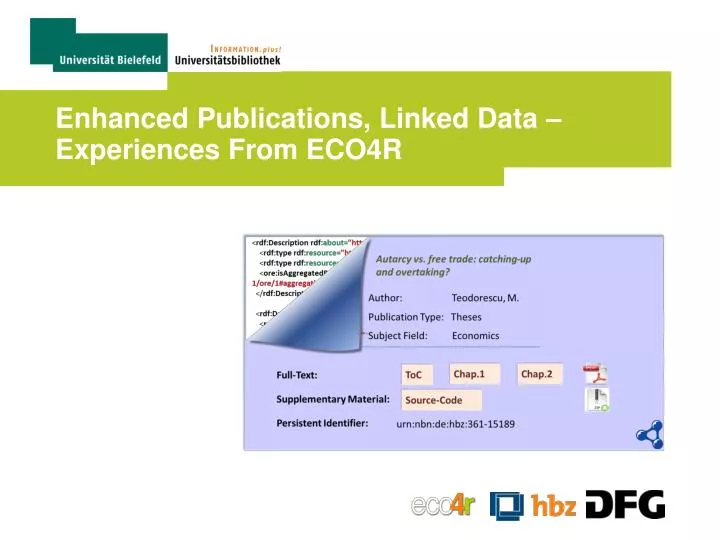
Pragmatic Data Model Approach in describing „Enhanced Publications“ • Based on OAI-ORE • To semantically describe the aggregative publication entities • Finding a compromise “Frbr Aligned Bibliographic Ontology” • Extends the FRBR entities (Work, Expression, Manifestation, Item) with more specific classes (e.g. JournalArticle, WebPage, SupplementaryInformationFile) • Complement to other ontologies in SPAR (Semantic Publishing and Referencing), which can describe a whole publishing workflow
Implementations done in ECO4R – I • Support of the data model by plugins in two fundamentally different repository platforms: • OPUS – most used platform in Germany, simple architecture with numerous limitations in file-handling • The 1st ORE support for this platform • Fedora – rather complex system, fine granularity in access modes, file management, versioning, audits • Refactoring of existing ORE implementations, compliant with the latest specification
Implementations done in ECO4R – II • Plugins neither need modifications of the internal repository data model nor the repository user-interface • A pragmatic way for making repositories linked data compliant • Authors of publications are not bothered • Overlay Journal – prototype as a prove of concept • Research project: operation not part of the plan
Overlay Journal as proof of concept • OAI-PMH Harvesting of ORE ResourceMaps • Persisting in a Triple-Store • Processing for the Overlay Journal (Broker) • Storing results in MySQL • Visualization for end-users • SPARQL interface for service providers
Re-Use Aspect demonstrated • Placeholder for User-Interface Screenshot Work in progress
Benefits for Linked Data compliant Aggregators • Descriptions of (Enhanced) Publications are compliant with web standards • Linking and enrichment by using terminology services, for e.g. • DDC, PND, Organizations (lobid.org), Projects (rkb-explorer) • Reliable links to e.g. full-text and datasets, when publication entities are semantically described • Improved retrieval interfaces by provision of a SPARQL endpoint
KO criteria for enforcing Linked Data Services • Interoperability: after the experiments and prototypes – which ontologies, vocabularies will survive ? • What about the maintenance of all the ontologies, vocabularies ? • Availability, Reliability and Quality of terminology services, SPARQL-Endpoints etc. • A fundamental requirement regarding the complex linking character of the Semantic Web
Enhanced Publications as LOD – a possible way with ‚concepts‘ are starting point << ORE / FABIO << Repository PlugIns << Enhanced pub.s as starting point << Demonstrator • Yes • machinereadable web-representationofrelations • No • datamissing • not designedfor human concepts • serviceprovidersaremissing
Plans • Open Source Release of the OAI-ORE repository plugins • Further developments for Dspace, Eprints? • Using the CARPET platform & DINI/OA-Netzwerk as hosts to further discuss and circulate the “Enhanced Publication” paradigm in Germany • Conceptualization (SKOS?) • linking to Enhanced Publication Developments in the NL • embedding in in EU (OpenAIREplus, euroCRIS) • Building aggregators (BASE?)
Thanks For Your Attention • The Project Team Members • Anouar Boulal, Jochen Schirrwagen, Martin Iordanidis, Andres Quast, Jan Schnasse, Friedrich Summann • Web-site: http://www.eco4r.org • Wiki: https://trac.eco4r.org