### Understanding Competitiveness: Key Indicators and CGE Implementation ###
210 likes | 335 Vues
This document provides a comprehensive overview of competitiveness at firm, sector, and national levels, examining definitions and performance indicators critical for assessing competitiveness. It delves into input/output-based metrics, data availability, and the compatibility of these indicators within a quantitative modeling framework. Furthermore, it discusses the application of computable general equilibrium (CGE) models, especially in the context of EU leadership in climate policy. The implications of emission reduction targets on international competitiveness and environmental effectiveness are analyzed. ###


### Understanding Competitiveness: Key Indicators and CGE Implementation ###
E N D
Presentation Transcript
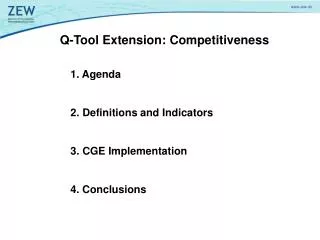
Q-Tool Extension: Competitiveness 1. Agenda 2. Definitions and Indicators 3. CGE Implementation 4. Conclusions
Agenda • Firm level (cost structure, innovation potential, ...) • Sectoral level (market shares, mark-ups, ...) • Country level (terms-of-trade,...) Specification of „Competitiveness“ • Input/output-based indicators • Data availability Review of existing indicator systems Compatibility with quantitative modeling framework • Implementation of indicators in CGE core-model • Illustrative policy application • (here: EU leadership in climate policy)
Selected Definitions Firm level: • „A firm is competitive if it can produce products [...] of superior quality or lower costs than its domestic and international competitors. (US-President`s Commission on Industrial Competitiveness 1985, S. 6) Sectoral level: • ... Position of a sector in relation to other sectors or to the same sector in other countries in terms of market share and productivity. National level: • “Competitiveness [...] is understood to mean a sustained rise in the standards of living of a nation and as low a level of involuntary unemployment possible.”(European Competitiveness Report 2004)
Indicators (1) “ex-post” “ex-ante” Input / Policy Based on: Output / Performance • R&D Expenditures • Stock of Human Capital • Cost Structure • Innovation Potential • Market share • Profitability • Productivity Firm level: • (Relative) market shares - RMS • Revealed Comparative Advantage - RCA • Productivity / Profitability • R&D expenditures • Investment flows (FDI) • Innovation Potential (Patents) Sectoral level: • Real Exchange Rate • Terms of Trade • Constant Market Shares (CMS) • Productivity • Per Capita Income • Balance of Current Account • Labour unit costs • R&D expenditures • Investment Flows (FDI) • Innovation Potential National level:
Indicators: RCA Revealed Comparative Advantage – RCA (Balassa 1965)
Application: EU Leadership in Climate Policy Issue: • Unilateral EU carbon emission constraints (e.g. EU-ETS) • Impacts on international competitiveness • Global environmental effectiveness (carbon leakage) Policy implementation: • Alternative emission reduction targets: • 5,10,15, 20, 25, 30% cutback of CO2 emissions compared to BaU • Endogenous tax differentiation: • Tax rates discriminated in favour of carbon-intensive industries • Tax ratios between other sectors and carbon-intensive industries:1 (uniform), 2, 5, 10, 20, inf (exemptions)
Parameterization of Static PACE Version Data base of global economy: GTAP V6 • Base year: 2001 • Coverage: 87 regions, 57 sectors, 5 factors Aggregation:
Results (6): RCA Change for Carbon-intensive Industries (EIS)
Results (7): RCA Change for Carbon-intensive Industries (EIS)
Conclusions CGE Implementation of selected competitiveness indicators: • At national level: (Per-capita) income, Terms of Trade, etc. • At sectoral level: RCA, RWA, etc. Cautious Use of Competitiveness Indicators: • Trade-off between indicator at the same level (e.g. sectors) • Trade-off between indicators at different levels (e.g. sector / nation) “ Competitiveness is a meaningless word when applied to national economies. And the obsession with competitiveness is both wrong and dangerous”. (P. Krugman (1994), Foreign Affairs, 1-17)