Simplifying Design with Structural Patterns: Relationships & Functionality
Learn how design patterns ease relationship realization between entities through object assembly, composition, and inheritance. Explore Composite, Facade, Proxy, Decorator, Adapter, Bridge, and Flyweight patterns with examples.

Simplifying Design with Structural Patterns: Relationships & Functionality
E N D
Presentation Transcript
Structural Patterns Design Patterns that ease the design by identifying a simple way to realize relationships between entities. Antony Jekov Telerik Software Academy academy.telerik.com Academy Intern http://jekov.telerik-students.org
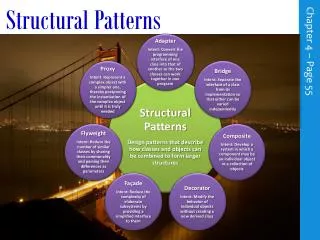
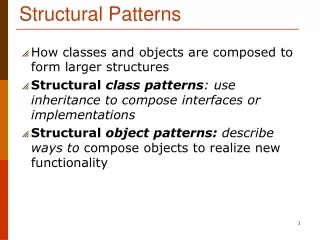
Describe ways to assemble objects to implement a new functionality Ease the design by identifying a simple way to implement relationships between entities This design patterns are all about Class and Object composition Structural class-creation patterns use inheritance to compose interfaces Structural object-patterns define ways to compose objects to obtain new functionality Structural Patterns
Facade Pattern • To deliver convenient interface from higher level to group of subsystems or single complex subsystem • Façade pattern used in many Win32 API based classes to hide Win32 complexity
Facade – Real World Example The hard way: popper.On(); popper.Pop(); amp.On(); amp.SetSurroundSound(); amp.SetVolume(10); amp.SetDvd(dvd); screen.Down(); lights.Dimm(20); projector.On(); projector.WideScreenMode(); dvd.On(); dvd.Play("Dzift"); The facade way homeTheater.WatchMovie("Dzift");
Composite Pattern • Composite Pattern allows to combine different types of objects in tree structures • Gives the possibility to treat the same individual objects or groups of objects • Used when • You have different objects and you want to treat them the same way • You want to presenthierarchy of objects
Composite Pattern – Example abstract class Shape { public abstract void Draw(); } class ConcreteShape : Shape { public override void Draw() { /*...*/ } } class ComplexShape : Shape { private List<Shape> ownedShapes; public override void Draw() { /*...*/ } } class Line : Shape { public override void Draw() { ... } } static void Main() { varrootShape = new ComplexShape(); /* ... */ }
The Proxy Pattern • An object representing another object • Provide a surrogate or placeholder for another object to control access to it • Use an extra level ofindirection to supportdistributed, controlled,or intelligent access • Add a wrapper anddelegation to protectthe real componentfrom undue complexity • Example: Web Service
Decorator Pattern • Add responsibilities to objects dynamically • Wrapping original component • Alternative to inheritance (class explosion) • Support Open-Closed principle • In .NET: CryptoStreamdecorates Stream
Adapter Pattern • Converts the given class' interface into another class requested by the client • Wrap an existing class with a new interface • Impedance match an oldcomponent to a new system • Allows classes to work together when this is impossible due to incompatible interfaces
Bridge Pattern • Used to divide the abstraction and its implementation (they are by default coupled) • That way both can be rewritten independently • Solves problems usually solved by inheritance • From: Abstraction -> ImplementationTo: Abstraction ->Abstraction ->Implementation
Bridge Pattern • Bridge Example
Proxy vs. Decorator vs.Adapter vs. Bridge • Proxy– to lazy-instantiate an object, or hide the fact that you're calling a remote service, or control access to the object (one-to-one interface) • Decorator – to add functionality to an objectruntime (not by extending that object's type) • Adapter – to map an abstract interface to another object which has similar functional role, but a different interface (changes interface for the client) • Bridge– define both the abstract interface and the underlying implementation. I.e. you're not adapting to some legacy or third-party code, you're the designer of all the code but you need to be able to swap out different implementations (all changeable)
Flyweight Pattern • Use sharing to support large numbers of fine-grained objects efficiently • Reduce storage costs for large number of objects • Share objects to be used in multiple contexts simultaneously • Retain object oriented granularity and flexibility
Design Patterns http://academy.telerik.com
Free Trainings @ Telerik Academy • C# Programming @ Telerik Academy • csharpfundamentals.telerik.com • Telerik Software Academy • academy.telerik.com • Telerik Academy @ Facebook • facebook.com/TelerikAcademy • Telerik Software Academy Forums • forums.academy.telerik.com