Download
1 / 12
120 likes | 235 Vues
The Vanderbilt University NPN Community Survey Spring 2012 provides an in-depth analysis of East Nashville's neighborhoods. With a sample size of 485 participants, aged 44 on average, the survey explores critical topics such as neighborhood resources, civic participation, social cohesion, and individual perceptions of social problems. Key findings highlight community assets and challenges, including food access, shared values among residents, and concerns about violence. The survey aims to identify differences across census tracts and inform about parent engagement and community health.

E N D
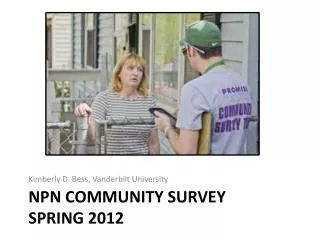
Kimberly D. Bess, Vanderbilt University NPN Community Survey Spring 2012
Survey Overview Door-to-Door # Of Census Tracts of Sampled: 11 Sample Size: 485 Average Participant Age: 44 Average # Years Living in East Nashville: 17 Number of Households w/Children Under 18 = 233
Main Survey Content • Neighborhood Resources • Civic Participation • Sense of Community • Social Cohesion • Social Control • Neighborhood Problems • Parent Engagement • Pre-K Enrollment • After-School Program Participation • Perceived Quality of Cluster Schools • Bullying • General Health of Participant/Child • Child Nutrition • Child Physical Activity
Research Questions • Do census tracts (117, 119, 192, & 193) targeted for NPN Phase 1 differ from other census tracts (111, 112, 114, 115, 116, 121, & 122) in the Stratford in relation to Social Capital, Health, or Experience in Cluster Schools? • What do community residents perceive as the biggest assets and challenges in their community?
Census Tracts Targeted in NPN Phase 1 Rosebank Ross Warner Kirkpatrick Phase 1 Phase 2
Do census tracts targeted in Phase 1 differ from other cluster census tracts? • 117 & 192 share a similar pattern • 119 & 193 share a similar pattern • There is a much higher perception of social problems in 193. • 117 has the highest social capital and is more similar to non-target census tracts. • Pattern: 117 -> 192 ->119 -> 193 An X indicates a significant difference between census tracts.
Sample Results Neighborhood Resources: I have a place where I can buy fresh fruits & vegetables Neighborhood Cohesion: People in my neighborhood share the same values
Sample Results Neighborhood Problems: Violence is a problem in my neighborhood.