Angle Relationships
This guide covers essential concepts in angle relationships, including adjacent angles (angles in the same plane with a common vertex and side but no common interior points), vertical angles (non-adjacent angles formed by intersecting lines), linear pairs (adjacent angles whose non-common sides are opposite rays), complementary angles (sum equals 90°), and supplementary angles (sum equals 180°). Examples illustrate these concepts, helping you find angle measures and relationships in various scenarios, such as perpendicular lines and their properties.

Angle Relationships
E N D
Presentation Transcript
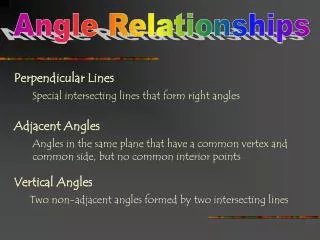
Pairs of Angles • Adjacent <s (adj <s) - angles in same plane with common vertex & side but no common interior points • Vertical <s (vert <s) – 2 non-adjacent angles formed by 2 intersecting lines • Linear Pair (linear pr) – adjacent angles whose non-common sides are opposite rays
Angle Relationships • Complementary <s (comp) – 2 angles whose sum is 90˚ • Supplementary <s (supp) – 2 angles whose sum is 180˚
Examples • 20 comp ____ 2. 93 comp ____ 3. 20 supp ____ 4. 93 supp ____ Find the measures of 2 supp angles if one angle is 6 less than 5 times the other angle:
Example – What can/cannot be assumed from the picture? m<VYT = 90 <TYW & <TYU are supp <VYW & <TYS are adj <s
Examples • Find measures of <ABG, <DBC, & <EBF: • Name an < adjacent to <EBD: • Name an < vertical to <DBA: • Name the compliment of <FBG: • Name the supplement of <ABC: • Which < forms a linear pair with <EBF? • Which pair of lines are perpendicular? • T or F: <DBC & <EBF are vertical <s. D C 90 38 E A B 30 F G