First-order linear equations
This guide provides an overview of first-order linear equations, including their definitions and forms. It explains the difference between homogeneous and inhomogeneous equations, with examples for clarity. The document introduces the integrating factor method for solving these equations, detailing how to select an appropriate integrating factor, (I(x)). Additionally, it covers examples of solving these equations and addresses initial value problems, aiding in comprehension of linear equations in mathematical contexts.

First-order linear equations
E N D
Presentation Transcript
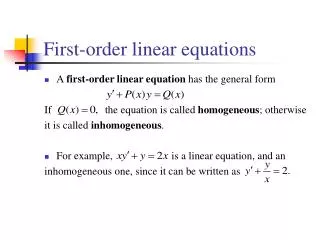
First-order linear equations • A first-order linear equation has the general form If the equation is called homogeneous; otherwise it is called inhomogeneous. • For example, is a linear equation, and an inhomogeneous one, since it can be written as
Integrating factor method • To solve the first-order linear equation we multiply the equation by a suitable function I(x): If the factor I(x) is chosen such that then equation (2) becomes which can be solved by
Integrating factor method • Thus the key point to solve equation (1) is to find I(x) such that equation (3) holds true: This is equivalent to which is a separable equation for I(x). Its solution is • Simply taking C=1, we call an integrating factor of equation (1).
Example • Ex. Solve the equation • Sol. An integrating factor is Multiplying I(x) to the equation, we get • Ex. Solve • Sol.
Example • Ex. Solve the equation • Sol. Not a linear equation? What if we treat x as dependent variable and y as independent variable:
Example • Ex. Solve the equation • Sol. • Ex. Solve the initial value problem • Sol.
Example • Ex. Solve the initial value problem • Sol.
Homework 22 • Section 9.3: 7, 10, 15 • Section 9.6: 12, 14, 19 • Page 648: 1