Catalog Changes: Guidelines and Procedures
Learn about forms 90, 90A, and 100 for degree program changes. Understand RME development stages and timelines. Follow steps for catalog changes and RME approval phases at Southern Illinois University Carbondale.

Catalog Changes: Guidelines and Procedures
E N D
Presentation Transcript
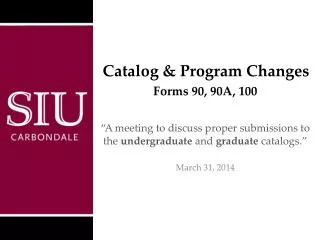
Southern Illinois University Carbondale Forms 90, 90A, 100 Catalog & Program Changes “A meeting to discuss proper submissions to the undergraduate and graduate catalogs.” March 31, 2014
Today’s Presenters • Jim Allen, Associate Provost for Academic Programs • Ruth O’Rourke,Administrative Assistant Transfer Student Services Representatives: • Tom Whittington, Administrative Coordinator • Suzanne Goad, Admissions & Records Officer Enrollment Management Representative: • Dana Tetzlaff, Administrative Clerk
Southern Illinois University Carbondale Today’s Agenda 10:00 The Complete Package: includes all necessary forms 90 and 90A to initiate changes in degree programs/courses. Question & Answers period immediately following presentation. 11:15 RME: Guidelines and Procedures, a brief overview of development stages and timelines for Reasonable and Moderate Extensions
The Complete Package for Catalog Changes • Form 90A : One 90A for each Program • Form 90s: Form 90s for all courses being modified (don’t forget cross-listed courses!) • Form 100s : To create, change, or drop a fee, a form 100 is required. • TEP: Teacher Education Programs must submit forms 90A and 90 specified as ‘TEP’.
Catalog Changes • Proofing pages • Process • Allowable edits • Timelines • Catalog publishing • 2014-15 Undergraduate Catalog • http://registrar.siu.edu/catalog/undergraduatecatalog.html
Steps and Guidelines for Developing and Processing Reasonable and Moderate Extensions (RMEs)
Step 1: The Development Phase
The Development Phase • Program faculty and department chair/director discuss plans for the program changes • Department chair/director discusses proposed changes with Dean and/or the appropriate Associate Dean to ensure these changes do not affect other academic units in the school or college • Department chair/director consults with the Office of the Associate Provost for Academic Programs (APAP) to review the forms and establish a timeline for their completion • Approximate time- less than 1 month • Sending the RME and Form 90A to the Office of the Associate Provost for Academic Programs
Step 2: The Approval Phase
The Approval Phase • Provost and Associate Provost for Academic Programs (APAP) review the completed proposal • APAP will forward RME to the Associate Provost for Academic Administration and the SIU Vice President for Academic Affairs for informal review • If proposal requires, the Graduate Dean and Director of the Office of Distance Education and Off-campus Programs may be included in the informal review
Step 3: The Article 9 Phase
The Article 9 Phase • RME will be reviewed for Article 9 requirements • If the RME is subject to Article 9 stipulations the Associate Provost for Academic Administration (APAA) will notify the APAP
The Article 9 Phase If the RME is subject to Article 9 stipulations the following steps will be taken before proceeding with the RME process
The Article 9 Phase • If the RME is not subject to Article 9 stipulations it will be submitted directly to constituency groups • For Graduate Program: • Electronically submitted to Graduate Council for Notice and Action from Provost • Not for Graduate Program: • Electronically submitted to Faculty Senate for Notice and Action from Provost
Step 4: Further Approval Phase * As of July 9, 2012
Further Approval Phase • Once the RME has been approved by Graduate Council or Faculty Senate the following steps will be taken to complete the RME approval process