Comet ISON: The Cosmic Event of 2013
Comet ISON, discovered by Russian astronomers in September 2012, is a sun-grazing comet expected to be a spectacular sight in late 2013. Its closest approach to Earth will occur on January 2, 2014, after a perihelion on November 28, 2013. As this massive visitor approaches from beyond Pluto, amateur and professional astronomers alike are gearing up for what could be the "Comet of the Century.” Observational opportunities include visual sightings in late September and October. Learn more about Comet ISON and its significance for upcoming missions like Rosetta.

Comet ISON: The Cosmic Event of 2013
E N D
Presentation Transcript
Comet ISONAwareness Briefing Coming Soon to Our World – Fall 2013…perhaps April 25, 2013 Science Mission Directorate
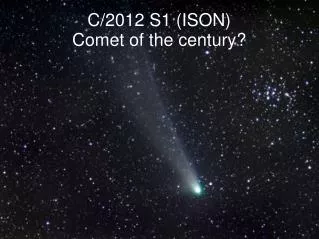
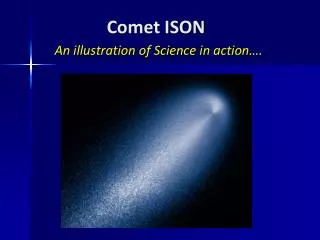
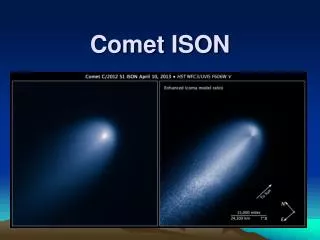
What is Comet ISON? An visitor from beyond the orbit of Pluto about the size of an Appalachian mountain, Comet ISON was discovered by Russian astronomers VitaliNevski and ArtyomNovichonok in September 2012. It's named after their night-sky survey program, the International Scientific Optical Network. Now near the orbit of Jupiter, this sun-grazing comet may be the cosmic event of the year.
Comet ISON Potential Observations Outbound Inbound • Inbound: Mars - Comet closest approach ~0.08 AU (Oct 4,2013) • Late Sept: Earth - 8-10” telescopes will be able to observe • Late Oct-Nov: Earth – Naked Eye Brightness • Perihelion: Sun – Comet closest approach Nov 28, 2013, ~0.008 AU! • Outbound: Earth - Comet closest approach ~0.44 AU (Jan 2, 2014) M V E M Earth-Comet M V E M Comet-Mars
From ScienceCast – “Comet of the Century” http://www.youtube.com/watch?v=5_1HdOCOJ_Q
Missions Asked to Observe Comet ISON (to date) • Deep Impact • Stereo • SDO • Juno • LRO • ISS • MSL/Curiosity • MRO • BRRISON • MESSENGER • SOHO • Hubble • Chandra • SWIFT • Rosetta • Ground-based Observatories: Keck, NASA/IRTF, KittPeak, Sac Peak, Big Bear • Amateur astronomy clubs Comet Lovejoy as seen from the International Space Station in late 2011.
Links • Dr. Kelly’s Overview: www.lpi.usra.edu/sbag/.../TUES_1345_Kelley_msk_comet_ison.pdf • Deep Impact: http://epoxi.umd.edu/3gallery/cometISON.shtml • Stereo: http://stereo-ssc.nascom.nasa.gov/comet_ison/ • http://sungrazer.nrl.navy.mil/index.php?p=ison • General Comet information: http://solarsystem.nasa.gov • http://solarsystem.nasa.gov/planets/profile.cfm?Object=Comets&Display=Events • Multimedia (coming soon) http://eyes.jpl.nasa.gov and http://1.usa.gov/10hbpsm
Connections • Comet Pan-STARRS and ISON provide awareness to the ESA/US ROSETTA mission in where we will be orbiting around and then landing on a Comet in November 2014 – May 2015, and the NASA New Horizons mission where we will be flying by a large icy comet-like body, Pluto, on July 14, 2015!