Download
1 / 32
320 likes | 463 Vues
Explore the fascinating concepts of Earth's rotation and the coordinate system of latitude and longitude. Learn how the 24-hour movement of the sun, stars, and moon can be explained through Earth's turning on its axis. This guide covers the importance of latitude and longitude in pinpointing locations, the significance of the Equator and Tropics, and how time zones are established based on Earth's rotation. Discover how these elements shape our understanding of spatial geography and timekeeping across the globe.

E N D
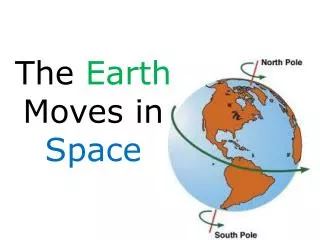
Aristarchus • The 24-hr movement of the sun, the stars, and the moon can be easily explained if the earth were turning. • Rotation • Turning of the earth on its axis
Coordinate System • A surface grid that has two numbers assigned to it • Means to find locations on the planet
Latitudeand Longitude • The coordinate system is based on two stars • The Sun and the Polaris
Latitude • Latitude values never intersect • Measures North and South of Equator • Max value - 90° North or South • Equator - 0° • Reference line
Latitude The Parallel lines of latitude are horizontal, running from east to west.
Equator • The imaginary line from which latitude is measured • It is half way between the poles, dividing the globe into the northern and southern hemisphere
Tropics • Tropic of Cancer – 23.5° North • This is the farthest north that the sun appears directly overhead • Happens around June 21 • Tropic of Capricorn – 23.5° South • This is the farthest south that the sun appears directly overhead • Happens around December 21
Tropics • Arctic Circle – 66.5 ° North • From the vernal equinox to the autumnal equinox, areas north of this latitude receive 24 hours of daylight • Antarctic Circle – 66.5 ° South • From the autumnal equinox to the vernal equinox, areas north of this latitude receive 24 hours of daylight
Longitude • Measures East and West of the Prime Meridian • Prime Meridian - 0° Greenwich,England • Max value - 180° International Date Line
Longitude The longitude lines run pole to pole
Telling Time • Earth Rotates 15° per hour • Time zones – 15° apart • Each time zone is 1 hour difference
As you go easttime does increaseAs you go westtime gets less