Download
1 / 9
90 likes | 209 Vues
This guide explores the concept of converting measurements between customary and metric units, focusing on practical examples. Learn to choose appropriate customary units for various measurements, such as weight and capacity, and practice converting units using proportions. Examples include determining the weight of a car in tons, the diameter of a soap can in inches, and the length of a 10-kilometer race in miles. Understand the relationship between fluid ounces, pints, and cups through clear examples and exercises.

E N D
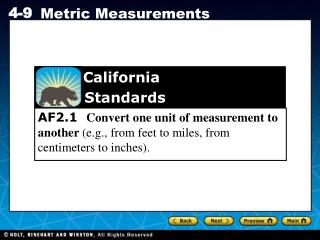
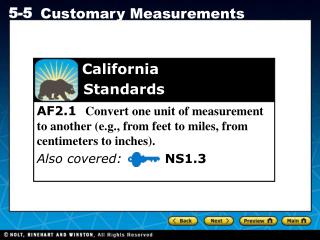
California Standards AF2.1 Convert one unit of measurement to another (e.g., from feet to miles, from centimeters to inches). Also covered: NS1.3
You can use the following benchmarks to help you understand fluid ounces, tons, and other customary units of measure. Write this on p 124.
Example 1: Choosing the Appropriate Customary Unit Choose the most appropriate customary unit for each measurement. Justify your answer. A. the weight of a car tons; The weight of a car is similar to the weight of a buffalo. B. the diameter of a soap can inches; The diameter of a soup can is similar to the length of a few paper clips. C. the weight of a newborn baby pounds; The weight of a newborn baby is similar to the weight of more than a dozen apples.
Example 2: Converting Customary Units Convert 5,000 pounds to tons. Write a proportion using a ratio of equivalent measures. mlx 5,000 tonspounds 1 2000 = 1 •5,000 = 2,000•x 2.5 = x 5,000 pounds is equal to 2.5 tons.
Example 3: Converting Between Metric and Customary Units One mile is about 1.6 kilometers. What is the length in miles of a 10 kilometer race? Round to the nearest tenth of a mile. Write a proportion using 1 mile 1.6 kilometers. miles kilometers 11.6 x 10 = 1.6 · x = 1 · 10 The cross products are equal. 1.6x = 10 Multiply. 1.6x 1.6 10 1.6 = Divide each side by 1.6. x 6.3 Round to the nearest whole number. The length of a 10 kilometer race is about 6.3 miles long.
Check It Out! Example 1 Choose the most appropriate customary unit for the measurement. Justify your answer. the capacity of a jar of peanut butter cups; The capacity of a jar of peanut butter is similar to the capacity of 2 standard measuring cups.
Check It Out! Example 2 Convert 24 pints to cups. Write a proportion using a ratio of equivalent measures. c 24 cups pints 21 = 1 •c = 2 • 24 c = 48 24 pints is equal to 48 cups.
Check It Out! Example 3 One cup is about 8 fluid ounces. What is the amount in cups of a 35 fluid ounce container? Round to the nearest tenth of a cup. Write a proportion using 1 cup = 8 fluid ounces. cups fluid ounces 18 x 35 = 8 · x = 1 · 35 The cross products are equal. 8x = 35 Multiply. 8x 8 35 8 = Divide each side by 8. x 4.4 Round to the nearest whole number. The amount of a 35 fluid ounce container is about 4.4 cups.