Cassini UVIS Io Plasma Torus Observations
190 likes | 314 Vues
This study analyzes observations of Io's plasma torus by the Cassini UVIS during a 45-day period (October 1 - November 14, 2000) to investigate azimuthal variations in torus composition driven by hot electrons. A significant period of 10.07 hours for these variations was identified, along with a 29-day amplitude cycle. Key modeling techniques include electron impact ionization and radial transport processes. Our findings reveal that changes in the hot electron population influence torus composition markedly, establishing their critical role in the dynamics of Io's plasma environment.


Cassini UVIS Io Plasma Torus Observations
E N D
Presentation Transcript
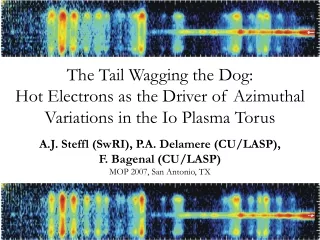
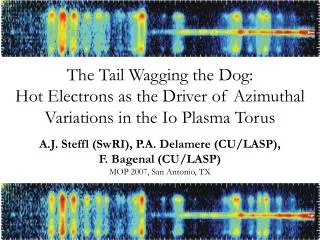
The Tail Wagging the Dog: Hot Electrons as the Driver of Azimuthal Variations in the Io Plasma TorusA.J. Steffl (SwRI), P.A. Delamere (CU/LASP), F. Bagenal (CU/LASP)MOP 2007, San Antonio, TX
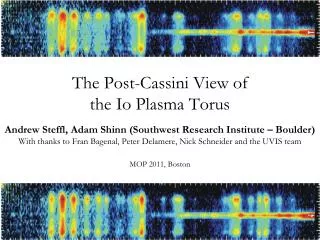
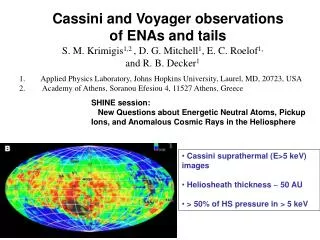
Cassini UVIS Io Plasma Torus Observations • 45-day observing period (1 October 2000 to 14 November 2000) • 1.904x10⁶ s of integration time • Individual integrations of 1000s • Duty cycle of roughly 53% • Fit spectra from ansae, extract composition
Phase of Azimuthal Variations with Time Slope yields a 10.07-hour period; System III period is 9.925 hours
Lomb-Scargle Periodogram Periodogram peak at 10.07 hours
Note about System IV System IV is not causedby the plasma rotation speed Thomas et al. (2001) Brown (1995)
Modeling Torus Chemistry 1 • Start with the torus chemistry model of Delamere and Bagenal [2003] • Model includes: • Electron impact ionization e.g. S + e- → S+ + 2e- • Charge exchange e.g. O + O+→ O++ O* • Recombination e.g. S++++ e-→ S++ + ν • Radiative cooling e.g. S++ + e-→ S++ + e- + ν • Coulomb collisions e.g. O++ S++ → O++ S++ • Mass & Energy Sources: • Extended neutral clouds • Pickup energy • Hot electron population (“hot” = 50 eV) • Loss Processes: • Fast Neutrals • Outward Radial Transport • Radiation (UV photons)
Modeling Torus Chemistry 2 • Five basic model parameters: • Neutral source rate SN • O/S neutrals ratio O/S • Fraction of hot electrons fh • Temperature of hot electrons Th • Radial transport timescale fh is, by far, the most sensitive model parameter
Azimuthal Model • Extend the basic model by including 24 azimuthal bins • Azimuthal transport of plasma at speed v (3 km/s) • Neutrals centered about the rotational equator • Plasma centered about centrifugal equator • 6.6º offset from rotational equator • All species are Gaussians about equator with scale height set by temperature • Ion-Neutral reactions most greatest at
Azimuthal Variation in Hot Electrons • A small change in fh rapidly produces a large change in torus composition • Add a sinusoidal azimuthal variation in hot electrons
Amplitude of Azimuthal Variations with Time 29 Days = 1/fSystem III - 1/f“System IV”
Dual Period Hot Electron Model • Add a second azimuthal variation in hot electrons • Fixed in System III • IV = 50% • III = 40% • III = 290º
When aligned System IV and System III variations produce large azimuthal variation in composition When anti-aligned, the torus is nearly azimuthally uniform.
Conclusions • Cassini UVIS observed significant azimuthal variations in torus composition • Azimuthal variations have a period of 10.07 hours • Slower than System III; faster than traditional System IV • Amplitude of azimuthal variations exhibits a 29-day cycle • A primary (50% variation) azimuthal variation in hot electrons rotates • A secondary (40% variation) variation in hot electrons remains fixed in System III • Peak at III=290°