
Efficient Event Handling in L2 Buffer Boards with CPU Trigger Mechanism
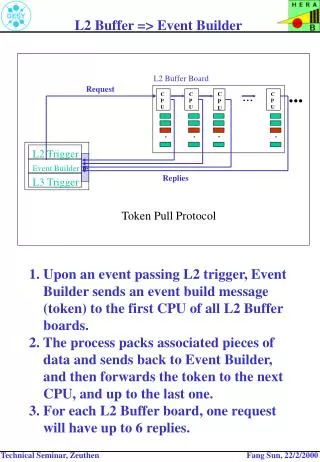
This document outlines a systematic approach to event handling in L2 Buffer boards utilizing CPU triggers. When an event passes an L2 trigger, the Event Builder sends a build message to the first CPU of all L2 Buffer boards. This process involves packing the relevant data, sending it back to the Event Builder, and forwarding the token to subsequent CPUs. Each L2 Buffer board handles up to six replies per request. This method enhances data flow efficiency and inter-board communication, contributing to optimized system performance. Authored by Fang Sun, dated February 22, 2000.

Efficient Event Handling in L2 Buffer Boards with CPU Trigger Mechanism
E N D
Presentation Transcript
C P U C P U C P U C P U ... . . . . L2 Trigger L3 Trigger Event Builder IF L2 Buffer => Event Builder L2 Buffer Board Request ... Replies Token Pull Protocol 1. Upon an event passing L2 trigger, Event Builder sends an event build message (token) to the first CPU of all L2 Buffer boards. 2. The process packs associated pieces of data and sends back to Event Builder, and then forwards the token to the next CPU, and up to the last one. 3. For each L2 Buffer board, one request will have up to 6 replies. Fang Sun, 22/2/2000