CSC 221: Introduction to Programming Fall 2012
370 likes | 536 Vues
Dive into the essentials of managing strings and lists in Python programming. This comprehensive guide covers basic string operations such as concatenation, slicing, and built-in methods. You'll learn how to implement list operations, including creation, indexing, and common methods like append, sort, and count. Discover the power of list comprehensions and how to incorporate user input to process data effectively. Suitable for beginners and experienced programmers alike, this resource will enhance your programming skills in CSC 221 and beyond.


CSC 221: Introduction to Programming Fall 2012
E N D
Presentation Transcript
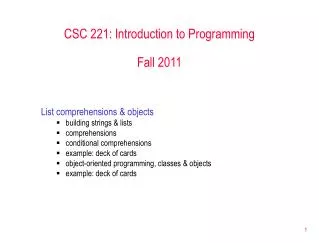
Lists lists as sequences list operations +, *, len, indexing, slicing, for-in, in example: dice stats from strings to lists list methods index, count, sort, reverse, append, extend, insert, remove building lists list comprehensions, conditional comprehensions big data CSC 221: Introduction to ProgrammingFall 2012
String review • recall that a Python string is a sequence of characters • basic operations on strings: • + concatenates strings • * concatenates multiple copies • len function • indexing via [i] • slicing via [s:e], [s:e:n], [:e], [s:], … • string methods: • isupper, islower, isalpha, isdigit, isspace • capitalize, upper, lower • find, rfind, count, replace • strip, lstrip, rstrip • center, ljust, rjust
Lists • closely related: a list is a sequence of arbitrary items • can specify the contents of a list in brackets, separated by commas • the same sequence operations apply to lists: • + concatenates lists • * concatenates multiple copies • len function • indexing via [i] • slicing via [s:e], [s:e:n], [:e], [s:], …
List operation examples note: a range is sequence similar to a list can be converted into a list using list
Exercises • grab a partner and go to codingbat.com • solve problems (in order) from the List-1 category • all of these problems can be solved using list indexing, slicing, +, and *
Traversing a list sequence • as with strings (character sequences), can traverse a list using for-in likewise, can test for list membership using in
Example: averaging numbers • suppose you have a list of numbers (e.g., grades) • want to calculate the average of those numbers • any potential problems? • i.e., will this function work correctly on all possible lists of numbers? modify this function so that it returns 0.0 on an empty list
Dice stats • recall earlier examples involving simulated dice rolls • suppose we wanted to perform repeated rolls, keep track of the number of 7's
Dice stats (cont.) • we could similarly define functions for the other dice totals • or, could generalize by adding a parameter for the desired total do these totals add up to 10,000? should they?
Dice stats (cont.) • the problem with separate calls for each dice total is that each call is independent of the others • actually simulating 10,000 x 11 different rolls • WASTEFUL, and leads to inconsistent results • what we need is to be able to count all the totals at the same time • could do it by having 11 variables, each keeping count for a dice total • would need an 11-case if-elif-else to check for each dice total • would then need to return or print each count
UGLY! • extremely tedious • what if we wanted to extend this example to 8-sided dice? • what would have to change?
Better solution • 11 separate variables are unwieldy – no way to test/update uniformly • alternatively, could place all 11 counters in a single list • actually, to simplify things will create a list with 13 numbers • twoCount will be stored in rollCount[2] • threeCount will be stored in rollCount[3] • … • twelveCount will be stored in rollCount[12]
Nicer output • simply returning the list of counts is not ideal • shows the placeholder numbers in indices 0 and 1 • difficult to see which number goes with which dice total
Generalized version • finally, could generalize to work for different dice • can even format the output to align the numbers
Strings & lists • there is a useful string method that converts a string into a list • str.split() returns a list of the separate words in str • by default, it uses whitespace to separate the words, but can provide an optional argument to specify different separators
Adding user interaction • since it is easier for the user to enter multiple items in a string, reading input as a string and then splitting into a list for processing is common • will the following work for averaging grades?
Adding user interaction (cont.) • not quite – split produces an array of strings • but, average is expecting a list of numbers • could go through the list and convert each string with the corresponding number • simpler, could have average convert each element to a number when processing
Mystery function • what does this function do?
Pig Latin revisited • if we want to convert a phrase into Pig Latin • split the string into individual words • use the pigLatin function to convert • append the Pig Latin words back together why the call to strip?
List methods • similar to string, the list type has useful methods defined for it • index(x) Return the index of the first occurrence of x (error if not in the list) • count(x) Return the number of times x appears in the list • sort() Sort the items of the list, in place • reverse() Reverse the elements of the list, in place • the following methods actually modify the contents of the list • unlike strings, lists are mutable objects • append(x) Add x to the end of the list • extend(L) Extend the list by appending all the items in L to end • insert(i, x) Insert x at a given position i • remove(x) Remove the first occurrence of x (error if not in the list)
More practice • grab a partner and go back to Codingbat • solve the first 3 problems from the List-2 category • these problems can be solved using a loop to traverse and inspect the list items
Review: building strings • we have seen numerous examples of building strings
Similarly: building lists • since lists & strings are both sequences, can similarly build lists
List comprehensions • Python has an alternative mechanism for building lists: comprehensions • inspired by math notation for defining sets • squares(N) = • in Python:[EXPR_ON_X for X in LIST]
Exercises: • use list comprehensions to build the following lists of numbers: • a list of all odd numbers from 1 to N • a list of all cubes from 1 to N • a list of the first N powers of 2 • given a list of words, use list comprehensions to build: • a list containing all of the same words, but capitalized • a list containing all of the same words, but each word reversed • a list containing the lengths of all of the same words
Throwaway comprehensions • comprehensions can be useful as part of bigger tasks
Another example note: the string method join appends the contents of a list into a single string, using the specified divider
Conditional comprehensions • comprehensions can include conditions • in general: [EXPR_ON_X for X in LIST if CONDITION]
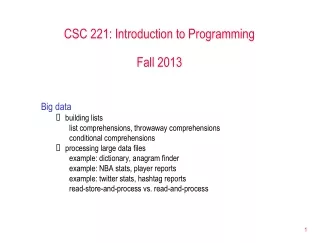
Big data • lists enable us to store and process large amounts of data • dictionary.txt contains 117,633 words • suppose we want to write a function that finds anagrams • will need to read in and store the dictionary • repeatedly prompt the user for a word • find & display all anagrams of that word in the dictionary • how can we determine if two words are anagrams? • generate the alphagram of each word: "spear" "aeprs" "pares" "aeprs • if the alphagrams are identical, the words are anagrams
2009 NBA stats • NBA2009.csv is a comma-separated data file • contains NBA stats from the 2009 season (from NBA
Stats list • we can read in the stats and store the data in a list • do we want a list of strings? ['Arron,Afflalo,DEN,82,2230,724,59,193,252,138,46,30,74,225,585,272,98,72,249,108', 'Alexis,Ajinca,CHR,6,30,10,1,3,4,0,1,1,2,5,10,5,1,0,0,0', 'LaMarcus,Aldridge,POR,78,2922,1393,192,435,627,160,67,48,104,231,1169,579,304,230,16,5', 'Joe,Alexander,CHI,8,29,4,2,3,5,2,1,1,0,9,6,1,3,2,1,0'] ... ] • or a list of lists [['Arron', 'Afflalo', 'DEN', '82', '2230', '724', '59', '193', '252', '138', '46', '30', '74', '225', '585', '272', '98', '72', '249', '108'], ['Alexis', 'Ajinca', 'CHR', '6', '30', '10', '1', '3', '4', '0', '1', '1', '2', '5', '10', '5', '1', '0', '0', '0'], ['LaMarcus', 'Aldridge', 'POR', '78', '2922', '1393', '192', '435', '627', '160', '67', '48', '104', '231', '1169', '579', '304', '230', '16', '5'], ... ]