Understanding Surface Areas of 3D Shapes: Prisms, Cylinders, Pyramids, and Spheres
This lesson focuses on calculating the surface areas and lateral areas of various three-dimensional shapes, including prisms, cylinders, pyramids, and spheres. It provides examples of finding cross-sections from horizontal and vertical slices of solids, emphasizing formulas for perimeter, base area, height, and slant height. Students will learn to derive exact and approximate values for different solids, including calculating the surface area of shapes like cones and hemispheres using given measurements. Engaging exercises will reinforce these concepts.

Understanding Surface Areas of 3D Shapes: Prisms, Cylinders, Pyramids, and Spheres
E N D
Presentation Transcript
Advanced Geometry Areas and Volumes Lesson 2 Surface Areas
Example: Describe the cross sections from a horizontal and vertical slice of each solid. Horizontal: hexagon Vertical: rectangle
Formulas Prisms & Cylinders Spheres Pyramids & Cones
B → Perimeter of the BASE Area of the BASE P → P B Formulas Add all sides h → height of the SOLID l → slant height of the SOLID
Example: Find the lateral area. When necessary provide both the exact values and approximate values to the nearest hundredth.
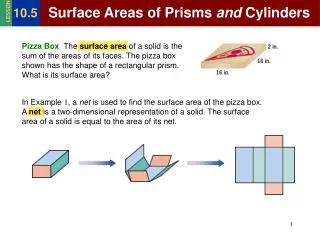
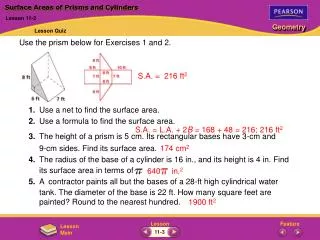
Example: Find the surface area of the regular prism.
Example: Find the lateral area.
Example: Find the surface area of the regular pyramid.
Example: Find the lateral area.
Example: Find the radius of the base of a right cylinder if the surface area is 528 square feet and the height is 10 feet.
Example: Find the surface area.
Example: The surface area of a cone is 20 square centimeters and the diameter is 3 centimeters. Find the slant height of the cone.
Example: Find the surface area of the sphere.
Example: Find the surface area of a sphere with the circumference of a great circle 5 centimeters.
Example: Find the surface area of a hemisphere with the radius of 3.8 inches.