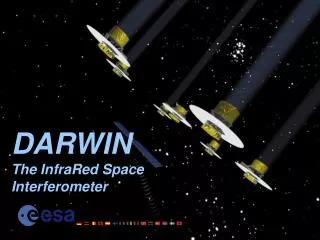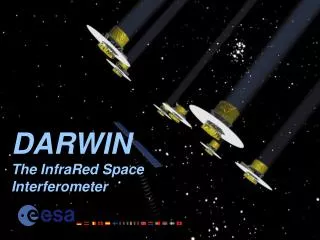
DARWIN The InfraRed Space Interferometer
190 likes | 341 Vues
The DARWIN Infrared Space Interferometer aims to enhance the search for exoplanets, focusing on solar-type stars and the characterization of Earth-like planets. With over 3,000 planets detected, the project targets precision measurements of radial velocity and employs advanced techniques like nulling interferometry to mitigate star radiation interference. DARWIN’s capabilities include detecting atmospheric signatures of potential life such as Ozone (O3) and water (H2O), making it a crucial tool for future astrobiological studies and collaboration with NASA's Terrestrial Planet Finder.


DARWIN The InfraRed Space Interferometer
E N D
Presentation Transcript
Status of exo-planet search Stars (Solar type) observed: +3000 Planets detected: ~ 86 Radial velocity measurement precision 1-2 m/s intrinsic limit? Earth requires 0.1 m/s • Occultation: • Planet orbiting HD209458 • P = 3.5 days • m = 0.7 Mjup • Rp = 1.4 Rjup
Search For Extrasolar PlanetsCOROT • COROT has two main scientific programs working simultaneously on adjacent regions of the sky: • ASTEROSEISMOLOGY • SEARCH FOR EXTRASOLAR PLANETS (“Super-Earths”- if they exist!)
Search For Extrasolar PlanetsEDDINGTON • Habitable Planets • Jupiter /Sun =1 % • Earth/ Sun = 8.4*10-5 • Mars/Sun = 3*10-5 • Photometric precision require space mission • EDDINGTON determines minimumsize of DARWIN
Direct detection of nearby Earths 7 106 Two major difficulties: 1. Contrast: 107 in the infrared for a Sun-Earth system 2. Angular Separation: 0.1 arcsec for a Sun-Earth system at 10pc Dynamic range and resolution
Searching for nearby Earths Light is drenched in radiation from the star Candle light 0.3m from lighthouse at a distance of 1000km
Nulling interferometer Dsin p Tele- scope 1 Recomb. Tele- scope 2
20 m 500 milli-arcsec NULLING INTERFEROMETRY Principle of a Bracewell nulling interferometer bright output 0 p dark output Transmission map Pupil plane recombination no image (the only thing we detect is an integrated flux)
The InfraRed Space InterferometerDARWIN • 6 telescopes (1.5m) • Hexagonal configuration • Beam combiner • Passive cooling (40 K)
Concept Infrared interferometer Multi-aperture : 1.5 m telescopes baselined Laurance class configuration Wide band spectroscopy Free-flyer Micropropulsion Laser & RF metrology Wavefront filtering Enabling technology – relaxes requirement on WF qualitiy
The InfraRed Space InterferometerDARWIN Venus Nulled Sun Mars Earth The Solar system as viewed from 10 pc on the 1:st of January 2001 with the Darwin baseline system
Characterizing nearby Earth’s • We thus not only want to detect planets similar to ours but also characterize them from the light they produce
Characterizing Earths Observed spectra Calculated atmospheric spectra (l/Dl = 200) H2O O3CO2 Photon m-2 s-1 300K BB 6 810 15 20 mm 6810 15 20 mm
Search for exo-life • Goal 2: Astrobiology • What is life? contains information can self-replicate can evolve • Life on Earth as a reference: • Carbon (organic) chemistry in water solution
Search for exo-life Presence of O3 = signature of life unlessnon-bioticproduction • Attempt to detect life by remote sensing. Probably one of the most difficult problems in observational astronomy… • Most likely criterion is simultaneous presence of liquid H2O together with presence of O2 • 1. O2 produced by life 2. O2 very reactive gas / rocks… if not continuously produced it vanishes in t < 10 million yrs 3. O3 better than O2. It is logaritmically dependant on amount of O2+ spectral lines in the IR
Search for exo-life • Qualifying the H2O / O3 criterion: • - for > 20 yrs, no abiotic production of O3 found when: • O3 with liquid H2O • atmosphere at T ~ 270 K (Habitable Zone) If criterion stands, organic life can be searched for
NASA’s Terrestrial Planet Finder Four 3.5m telescopes Identical objectives to Darwin Good basis for future collaboration