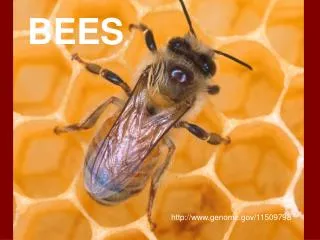

Know Your Bees
E N D
Presentation Transcript
Know Your Bees The Beekeepers of Indiana May 13, 2018
Know Your Bees • Wasp Family • Paper Wasps • Hornets • Yellow Jackets • Mud Daubers • Mason Bees • Carpenter Bees • Bumble Bees • Honey Bees
Which One is the Honey Bee? A B Honey Bee Yellow Jacket C D Bumble Bee Hornet The Answer is: A
Paper Wasps • Build Umbrella Like Nests • Mostly Around Doors and in Boxes • Less Aggressive Than Hornets and Yellow Jackets • Sting Multiple Times • Eliminate with Spray • Sunset or very early in the morning • Do not stand directly under the nest • After 24 hours, knock down the nest • Scrape and bleach the stem start • ¾” Long • Die During the Winter
Hornets • Build Tear Drop Shaped Enclosed Nests • Single Opening Usually on Bottom • Mostly on Limbs and Bushes • Extremely Aggressive • Sting Multiple Times • Eliminate with Spray • Treat Wearing Full Suit • Sunset, Cover with bag • After 24 hours, remove the nest • 2” Long • Die During the Winter
Yellow Jackets • Mostly Nest in the Ground • Often Mistaken for Honey Bees • Extremely Aggressive • Sting Multiple Times • Eliminate with Spray or Hot Water • Late at Night • Dig up nest and destroy • ½” Long • Die During the Winter
Mud Daubers • Nest on Side of Buildings • Tube-like Cells • Less Aggressive • Rarely Sting • Eliminate with Spray • Smash the tubes • Remove tubes • ½” to 1” Long • Die During the Winter
Mason Bees • In Wood, Twigs, • Native to American • Great Pollinators • Do Not Make Honey or Beeswax • Every Female Has Own Nest • Males Emerge First Each Spring • Elimination Not Required • 1/4” to 3/8” Long • Stay In Cocoon Until Spring • Revisit Old Nests
Carpenter Bees • In Wood, Drill Near Perfect Round Hole • Nest is Much Larger, • Shiny Black Adomen • Rarely Sting, Male Has No Stinger • Size Is Scary • Elimination Requires Treating the Nest • Use a long residual dust • Long nozzle sprayer • 1” Long • Hibernate During the Winter • Revisit Old Nests
Bumble Bees • Usually on the Ground • Under a Tarp or Deck • Late Summer Queens Find Loose Bark • Avoid Human Contact • Less Aggressive • Can Sting Multiple Times • Elimination • Clean up area, or • Pest Control Professionals; Cypermethrin • ¾” to 1 ½” Long • Die During the Winter
Honey Bees • Inside Treesand Structure • Wax Comb • Less Aggressive • Can Only Sting Once • Aggravated by Vibration, Loud Noises, Smell • Scrape the Stinger • Call a Beekeeper • ½” to ¾” Long • Do Not Die During the Winter • Hive May Have 10 to 50k
Does and Don’ts • Hit It With a Stick • Shoot It With a Gun • Wave Your Hands • Attempt to Eliminate Yourself • Do Not Use Lawn Mower Until Bees are Neutralized • Do Not Cut Down the Tree Until Bees are Neutralized • Honey Bee Stings • Pull a stinger out with your nails • Scrape the stinger out
If You Get Stung • Use a Cold Compress Where Stung • remove the stinger first then apply a chopped white onion to the area. The anti-inflammatory properties of the onion will reduce the swelling and draw out the poison to speed up the healing process. • Take an Antihistamine • 3% Have an Allergic Reaction • Redness • Painfull • Swelling • Itching • 0.8% Life-threatening Allergic • Hives • Difficulty breathing or swallowing • Wheezing or similar symptoms
Additional Information • Mike and Debbie Seib • 317-432-4352 Mike’s Cell • 317-432-9578 Debbie’s Cell • mike@seibshoosierhoney.com • Kathleen Prough • 317-412-3315 Cell • kprough@dnr.IN.gov