Understanding Water: Properties, Solutions, and the Role of pH in Life
This overview explores the essential properties of water, highlighting its unique molecular structure that leads to hydrogen bonding. Key characteristics include high specific heat, cohesion, and adhesion, which play crucial roles in maintaining a stable environment for life. The section on solutions clarifies the terms solute and solvent, emphasizing the importance of water. Additionally, we discuss the pH scale, its measurement of H+ ions, and its critical role in maintaining life's chemical balance. Finally, we touch on carbohydrates, their structure, and function in living organisms.

Understanding Water: Properties, Solutions, and the Role of pH in Life
E N D
Presentation Transcript
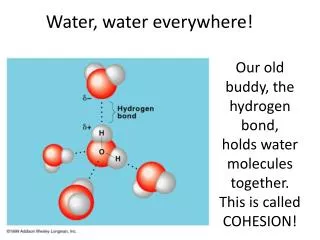
Water Basics • Polar: part of the molecule is slightly positive… other part slightly negative • Oxygen (-) • Hydrogen (+) • Hydrogen bond (+) connects one molecule to another
Water Properties • Energy needed to break H bonds • High specific heat: Water resists temp changes • Helps to maintain a constant body temp • Cohesion: water molecules attracted to other water molecules • Adhesion: water sticks to other molecules
Solutions • Solution: mixture where 1 substance dissolves in another • Solute: substance that dissolves in a solution • Atoms, ions, molecules • Solvent: substance in which the solute is dissolve • Usually water • Solution Ex: Blood Plasma
pH Scale • Some compounds release H+ ions when dissolved • pH scale measures the amount of H+ ions • H+ ions accumulate (acids) • More H+ ions = more acidic • pH balance vital to life
pH Scale • Ionization in solutions HCl H + Cl (more H ions) H2O H + OH (equal balance) NaOH Na + OH (more OH ions) + - + + - + - -
Carbohydrates • C: H: O = 1: 2: 1 • Readily available food source • Monosaccharides • Simple sugars • Bond by dehydration synthesis • Di- or polysaccharide is created
Polysaccharide • Long chain of monosaccharides (no fixed length) • Starch (pictured) : excess plant sugar converted & stored • Glycogen: animal starch stored in liver & muscles • Cellulose: used in plants to make cell walls